
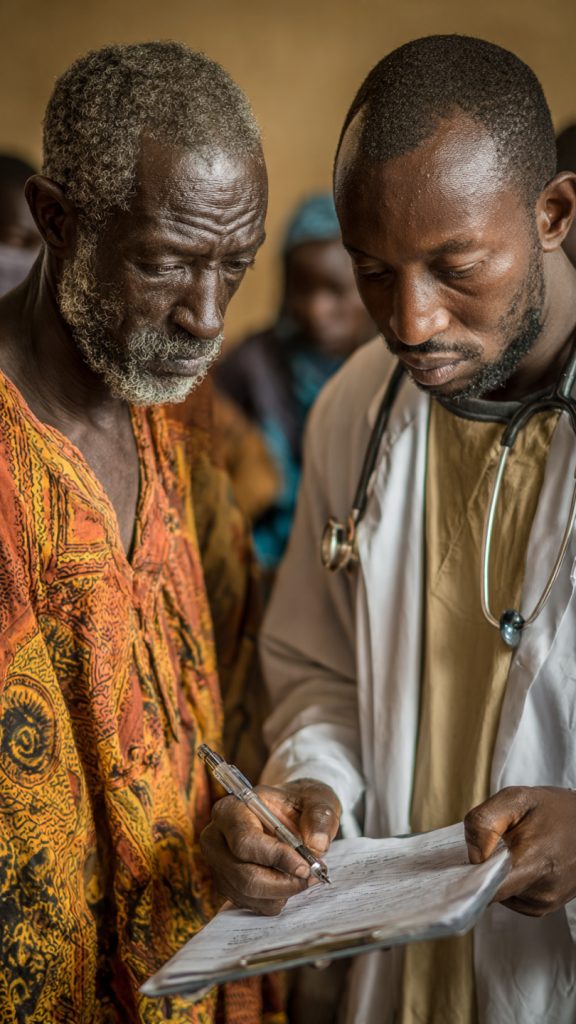
Barriers to Healthcare Access for Diet‑Related Non‑Communicable Diseases (NCDs) Among Undocumented African Migrants in South Africa
Introduction: A Hidden Burden in Plain Sight
“ I worry when my chest feels tight and I cannot eat; but I dare not go to the clinic. I might be turned away.” — interview with an undocumented migrant in Pretoria (2023)
As South Africa intensifies its response to non‑communicable diseases (NCDs), undocumented migrants often remain invisible. Yet, this population faces unique vulnerabilities — including diet-related NCDs like hypertension and diabetes — compounded by structural, legal, and social barriers to care.
Recent global calls, such as from the World Health Organization (WHO) and Médecins Sans Frontières (MSF), highlight the urgency of inclusive NCD strategies that leave no one behind. World Health Organization+2World Health Organization+2 In South Africa — home to millions of migrants — undocumented individuals bearing the burden of poor diet, urban stress, precarious living and working conditions remain largely outside effective NCD prevention and care.
This post explores the barriers to healthcare access for diet‑related NCDs among undocumented African migrants in South Africa. It analyses structural, legal and social determinants of health inequality; draws on empirical evidence and anonymized cases; and suggests innovative, feasible solutions for policy makers, NGOs and practitioners.
The Context: Migration, Diet, and NCD Risk
Migration and dietary transitions
Migrants often experience a dramatic shift in their food environment.
-
As they settle in urban centres, many adopt more processed, energy-dense diets high in salt, sugar, and saturated fats — departing from traditional diets. In South Africa, diet is a documented risk factor for hypertension among African migrants. PMC+2SpringerLink+2
-
A recent analysis showed that consumption of processed meats, salted snacks, and other processed food groups was significantly associated with hypertension, diabetes, cardiac events and other chronic conditions in the South African population. Cambridge University Press & Assessment
-
The process of “dietary acculturation” — adapting to the food environment of the host society — often occurs under constraints: low income, long working hours, insecure housing, limited food storage or cooking facilities. This exacerbates the risk of NCDs. PubMed+1
Thus, undocumented migrants in South Africa likely face elevated risk of diet-related NCDs. Yet, the health system often fails to support their prevention, screening or treatment.
NCD burden in South African migrants and non-migrants
Even among the general population, NCDs constitute a major health challenge: in one large national survey, non-communicable conditions accounted for a substantial share of morbidity and mortality. SpringerLink+1
For migrants, the health burden may be shaped by additional stressors — economic insecurity, poor housing, social exclusion — that amplify risk. The WHO’s migration‑health guidance notes that migrants often face a “double burden”: increased exposure to NCD risk factors, together with limited access to health services across the migration cycle. World Health Organization+2WHO | Regional Office for Africa+2
However, despite these risks, many undocumented migrants remain outside the formal radar of NCD prevention and care efforts.
Barriers to Healthcare Access: Structural, Legal, Social
Legal and policy barriers
-
In principle, South African law provides for the right to healthcare for “everyone”, irrespective of nationality or documentation status. IOM Pretoria+2SpringerLink+2
-
Yet, a recent study covering 2022–2025 documents a trend of “legal regression and policy securitisation,” where new legislation and policy changes increasingly narrow access for asylum seekers, refugees, and undocumented migrants. SpringerLink
-
According to that study, informal exclusion through administrative discretion — e.g., demanding identification, misclassifying migrants, or charging fees — is now becoming normalized in practice. SpringerLink+1
-
From a financing perspective, the health system lacks mechanisms to recover costs for treatment provided to undocumented migrants. As noted by the Minister of Health in 2025, provincial departments cannot reclaim unpaid treatment costs from migrants’ countries of origin. Diamond Fields Advertiser
-
Further, the absence of systematic data collection on patient nationality or legal status undermines any effort to monitor or plan for migrant health needs in the public system. Diamond Fields Advertiser+1
Implication: Even when policy frameworks nominally guarantee care, recent legal and administrative shifts — combined with structural under‑resourcing — effectively exclude many undocumented migrants from accessing comprehensive NCD care.
Health system and service‑delivery barriers
-
According to a global qualitative review (2023) of undocumented migrants’ access to health systems in low- and middle-income countries, barriers are often rooted in intertwined factors: high cost, bureaucratic inefficiencies, unclear policies, discrimination, and lack of culturally or linguistically appropriate services. PubMed+1
-
Although NCD services (prevention, diagnosis, treatment, continuum of care) are critical, such services remain unevenly available and affordable in many LMICs — including South Africa. NCBI+1
-
For undocumented migrants, irregular legal status often leads to delayed or foregone care, especially for non-emergency, chronic conditions like NCDs — because their use of primary care is more limited compared to documented or citizen populations. World Health Organization+2SpringerLink+2
-
A qualitative study among undocumented migrants in Pretoria found that many reported outright refusal of services, discriminatory attitudes, language barriers, long waiting times, and harassing behaviour by staff — discouraging them from returning for follow-up or chronic care. PHC FM+1
-
Financial constraints further hinder access. Many migrants cannot afford private healthcare, and public facilities sometimes charge or deny subsidized care to those lacking documentation. PHC FM+2IOM Pretoria+2
Implication: For a condition such as hypertension or diabetes — which requires regular monitoring, medication, lifestyle advice — such systemic barriers mean that undocumented migrants are unlikely to receive consistent, quality care.
Social and cultural barriers: xenophobia, fear, stigma
-
Undocumented migrants commonly experience “medical xenophobia” — defined as discrimination, refusal of service, neglect or mistreatment by health personnel due to national origin or documentation status. This has been documented repeatedly in South African studies. PMC+2HIV Justice Network+2
-
Fear of deportation or arrest deters many from seeking care, even when in need. Gauteng+1
-
Language barriers and lack of culturally‑appropriate communication also impair care: in the Pretoria study, many migrants reported that nurses communicated in local vernacular languages (e.g., isiZulu, seTswana), which they did not understand — leading to misunderstanding of dosage instructions, discouragement, and poor treatment adherence. PMC
-
Social marginalization, lack of trust in the health system, precarious livelihoods (long working hours, informal work, unstable housing) further reduce capacity to attend appointments, store medications, or maintain healthy diets.
Implication: Even where services exist, the social environment deters undocumented migrants from utilising them. For chronic, diet-related NCDs that require trust, consistency, and supportive follow-up, these social barriers can be as harmful as formal exclusion.
Real-Life Illustrations (Anonymised)
Case 1: “Maria” — urban informal settlement, Johannesburg
Maria is a 42‑year-old Zimbabwean woman living undocumented in a crowded informal settlement in Johannesburg. She developed elevated blood pressure several years ago after arriving in the city. Eating mostly cheap bread, instant noodles and salted processed foods — because fresh produce is unaffordable and sporadic — she gained weight and recently experienced headaches and dizziness. She knows she should get her blood pressure checked. But when she tried to visit a public clinic, staff demanded an ID or residence permit; she was told to come back another time. Her fear of being asked for documentation, and the prospect of xenophobic treatment, discouraged her. She now buys salt-free herbal teas from a street vendor but has never had her blood pressure measured in the past two years.
Case 2: “Samuel” — male, informal labourer, Pretoria
Samuel, 35, comes from Mozambique. He works long hours at low pay and often shares a single room with multiple others. He eats at irregular times, often relying on cheap processed snacks. After a minor stroke symptom — tingling in his feet — he considered visiting a clinic. However, a fellow undocumented friend told him about an experience at a Pretoria clinic where a nurse shouted at a fellow migrant in front of others, calling him “illegal foreigner” and refusing to give chronic medication. Terrified, Samuel turned away and now only buys occasional painkillers from informal shops.
These are not isolated stories. The qualitative study by Centre for Learning on Evaluation and Results Anglophone Africa & University of Pretoria interviewed 13 undocumented Zimbabwean migrants; most reported discrimination, long queues, language barriers, frustration and fear — all driving them away from subsidised public care. PHC FM+2UPSpace Repository+2
Why Existing NCD Strategies Fail Undocumented Migrants
Despite growing national focus on NCDs — for example, the 2024 NCD campaign launched by the South African health ministry in partnership with WHO. WHO | Regional Office for Africa+1
-
National NCD strategies seldom mention migrants — especially those without documentation. As noted by WHO, many national NCD or health-promotion strategies exclude refugees and migrants. World Health Organization+1
-
Lack of data: health information systems rarely record migration status or nationality. As the Minister recently admitted, provincial departments do not segregate or even identify undocumented patients. Diamond Fields Advertiser+1
-
Funding and accountability mechanisms rarely consider the cost of chronic care for migrants. There is currently no mechanism to reclaim costs from migrants’ countries of origin — meaning public health departments bear the full burden, which many view as unsustainable. Diamond Fields Advertiser
-
Civil society and NGO efforts remain patchy and under-resourced. As argued by the 2025 study on healthcare exclusion, civil society fills gaps — but cannot substitute for an inclusive, well‑resourced, state‑led response. SpringerLink
In effect, policy and practice combine to exclude undocumented migrants from NCD care — undermining public health, equity, and human rights.
Towards Solutions: What Has Worked — and What Could
While the challenges are daunting, several promising entry points and interventions can help bridge the gap.
Emerging good practice: NGO‑led NCD projects
-
In 2025, MSF launched an NCD project in the Eastern Cape aimed at improving identification and management of chronic diseases (e.g., diabetes, hypertension), including among vulnerable populations. MSF Southern Africa
-
Global evidence reviewed by WHO and partners recommends designing NCD interventions that are culturally sensitive, migrant‑inclusive, and integrated across the continuum of care — from prevention to long-term management. NCBI+2World Health Organization+2
These efforts show that it is possible to design responsive NCD care frameworks that serve migrants, including those with precarious legal status.
Key principles for effective, inclusive NCD care
Based on international guidance and South African context, I propose the following foundational principles:
-
Legal and policy inclusion: Explicitly include undocumented migrants in national NCD strategies and guarantee access to prevention, screening, diagnosis and long-term care regardless of legal status.
-
Health system adaptation: Strengthen primary health care infrastructure with migrant‑sensitive services — e.g., translation, flexible hours, outreach screening camps in migrant communities, and mobile clinics.
-
Data and surveillance: Implement anonymized data collection on migration status (without risking deportation), to monitor NCD burden, service use, and unmet needs.
-
Funding and accountability: Allocate dedicated resources for migrant-inclusive NCD care; consider cost-sharing mechanisms that do not exclude the undocumented.
-
Community engagement & health literacy: Work with migrant-led organisations, community networks, and NGOs to raise awareness about diet, physical activity, NCD risks — and facilitate trust in public services.
-
Intersectoral action: Address social determinants of NCD risk — food insecurity, poor housing, unstable employment, stress — through urban planning, labour regulation, social protection, and food policy.
Concrete Recommendations & Implementation Timeline (for South Africa)
| Timeframe | Action | Responsible Stakeholders |
|---|---|---|
| 0–6 months | Amend national NCD strategy & guidelines to explicitly include migrants (all documentation statuses) | National Department of Health (NDoH), Parliament, civil society advocates |
| 6–12 months | Launch pilot migrant‑inclusive NCD services in high-migrant urban areas (e.g., Johannesburg, Pretoria, Cape Town) — mobile clinics, community outreach, translation services | Provincial Departments of Health, NGOs (e.g., MSF), migrant‑led groups |
| 6–18 months | Implement anonymized data collection on migration status in health information systems (with safeguards) | NDoH, hospital management, health information units |
| 12–24 months | Develop and fund a “migrant health fund” or dedicated budget line for NCD care of undocumented migrants | NDoH, National Treasury, Provincial Health Departments |
| 12–36 months | Launch community-led NCD prevention and health‑literacy campaigns targeting migrant communities (nutrition, diet, physical activity) | NGOs, migrant associations, community health workers, local municipalities |
| Ongoing | Monitor, evaluate and document outcomes — uptake, coverage, NCD control rates, barriers — adjust and scale successful models | NDoH, researchers, civil society |
Conclusion: Why Inclusion Matters — for Public Health, Equity, and Rights
Undocumented African migrants in South Africa carry a silent burden of diet-related NCDs. Their risk is heightened by structural vulnerabilities — food insecurity, poor housing, economic precarity — and yet the health system increasingly excludes them through a mixture of legal regression, administrative discretion, xenophobia, and neglect.
Failing to include migrants in NCD prevention and care undermines public health, violates human rights, and deepens inequities. Conversely, inclusive strategies can yield multiple benefits: healthier migrants, reduced long-term health system costs, and stronger social cohesion.
I call on policymakers, health practitioners, NGOs and migrant-led organisations to act urgently. Begin by embedding migrant‑inclusive provisions in NCD policy, piloting community-based care models, allocating resources, and building trust. Only then can South Africa start to live up to its constitutional commitment to “health for all” — and ensure that diet‑related NCDs do not become a silent epidemic among its most vulnerable residents.
Limitations & Research Gaps
-
There remains a paucity of quantitative data on NCD prevalence, diagnosis, treatment, and outcomes among undocumented migrants in South Africa.
-
Lack of disaggregated data by documentation status, nationality, gender, age hampers targeted interventions.
-
We need longitudinal studies — to track NCD incidence, adherence to treatment, the impact of social determinants over time.
-
More research into culturally appropriate dietary interventions and community-based NCD management for migrant populations is essential.
Recent Posts:
- How Do Transnational Food Networks Shape Food Sovereignty and Cultural Identity for African Migrant Communities?
- What Is the Relationship Between Migration Status and Nutritional Transition Among African Migrants in Urban South Africa?
- How Does Food Insecurity Among African Migrants in South Africa Compare to Host Population Vulnerabilities?
- Chronic Disease Management Among Migrant Populations: Diabetes and Hypertension Care Access in Pretoria’s Migrant Communities
- Food Remittance Systems: How Somali Migrants Navigate Transnational Food Networks in South Africa