
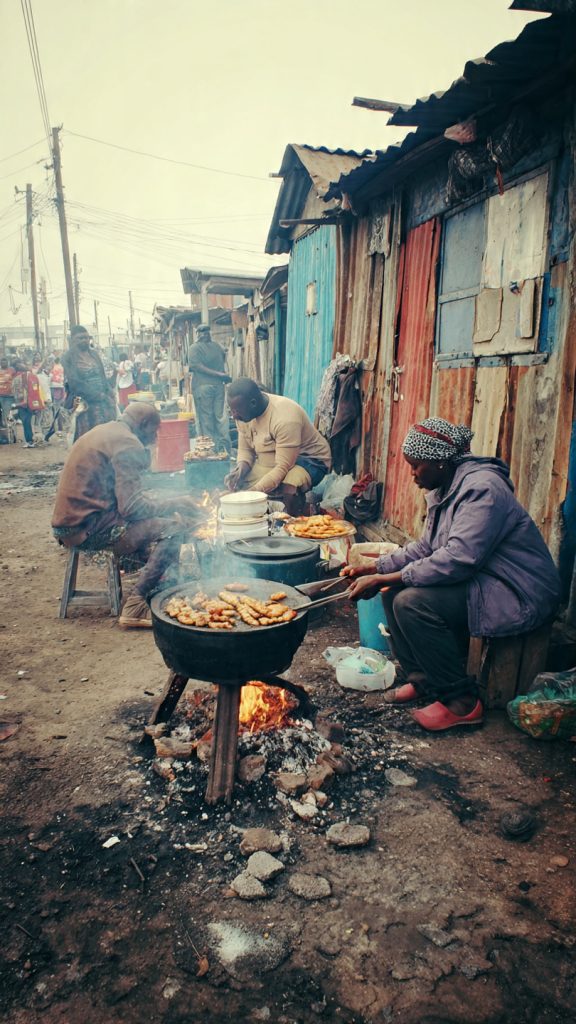
Xenophobia and Migrant Food Vendors in South Africa
In a dusty corner of inner‑city Johannesburg, 34‑year-old “Amina” (pseudonym), a Zimbabwean national, set up a small open‑air stall selling maize meal and fresh produce. On many days, she brought affordable staples to working‑class households who lacked access to supermarkets. But on 1 September 2019 — during the outbreak of what became known as the 2019 Johannesburg riots — a gang looted her produce, torched nearby stalls, and drove her customers away. She shut down for weeks.
Her story captures a broader reality: across South Africa, African migrant food vendors — key actors in the informal food economy — bear the double burden of economic precarity and xenophobic hostility. These pressures undermine their livelihoods and, in turn, threaten food security for tens of thousands of low‑income households that depend on their services.
Recent empirical studies increasingly document this dynamic: migrants supply affordable, accessible food in low‑income neighbourhoods, yet pervasive xenophobia — from violent attacks to systemic exclusion — undermines their ability to operate. Unisa Press Journals+2SpringerLink+2
This post examines how xenophobia affects food security and livelihood strategies among African migrant food vendors, explores resilience mechanisms, and proposes policy‑relevant solutions.
The Informal Food Economy and Migrant Vendors: Role & Importance
Migrants as Key Food Suppliers
-
Informal food vending plays a central role in providing accessible, low‑cost food to households in low‑income urban areas — often where formal supermarkets are scarce or inaccessible. SpringerLink+2Scholars Commons+2
-
A recent article on migrant informal food traders in Johannesburg highlights how these vendors enable food security for many families despite facing constant harassment and xenophobic pressure. Unisa Press Journals+1
-
For many migrant food vendors, running a stall or “spaza‑style” operation is not just a business — it is the only viable livelihood option, especially for those excluded from formal employment due to documentation, discrimination, or skills mismatch. International Organization for Migration+2SAMP+2
Precarity as Structural Feature
-
Informal traders — including migrants — typically operate without formal registration, lack social protection, and are vulnerable to harassment, theft, and arbitrary policing. GroundUp News+2SIHMA+2
-
The absence of stable income, lack of access to credit, and absence of institutional support render these livelihoods fragile, especially in times of economic or social shock. MiFOOD Network+1
Given this context, migrant vendors contribute significantly to urban food systems, yet remain highly exposed to disruptions from xenophobia, structural exclusion, and episodic violence.
How Xenophobia Undermines Livelihoods and Food Security
Violence, Looting, Displacement
-
Since at least the early 2000s, xenophobic violence has repeatedly targeted migrant‑owned informal businesses. The worst‑known wave is the May 2008 South Africa riots, which resulted in over 60 deaths and extensive destruction of migrant‑owned shops and stalls. Wikipedia+2SAMP+2
-
More recently, outbreaks of xenophobic attacks have again disrupted informal economies. Migrant traders are subject to looting, arson, and physical violence — often with limited police protection or follow-up. SpringerLink+2SIHMA+2
-
The damage is not just physical. The fear of violence forces many to shut shop, hide, or relocate — severing supply routes for communities that depend on them for affordable food. SpringerLink+2SIHMA+2
These attacks do not only injure individuals — they erode the food‑access infrastructure on which vulnerable households heavily rely.
Economic Exclusion and Structural Barriers
-
According to Gauteng City‑Region Observatory (GCRO) research, informal‑economy business re‑registration processes — such as those after operations like “Operation Clean Sweep” in Johannesburg — attempted to limit access to South Africans only. Even if migrants operated legitimate businesses, municipal bylaws and re‑registration requirements effectively excluded many from participating. GCRO+1
-
Even when migrants persevere, they encounter routine harassment: regular extortion, bribes demanded by officials, police confiscations of goods, and threats tied to undocumented status. GroundUp News+2SIHMA+2
-
During crises — such as the COVID-19 pandemic — migrant informal food enterprises were often excluded from relief measures that targeted formal workers or formal businesses. In Cape Town, a survey showed that none of the migrant food vendors had received government relief despite dramatic drops in income. MiFOOD Network+1
Thus, xenophobia intersects with structural exclusion to worsen precarity, reduce economic opportunities for migrants, and impair food supply for urban poor households.
Impact on Food Security for Migrants and Communities
-
When migrant vendors close or reduce operations under pressure, low-income households lose a critical source of affordable food. In contexts where formal markets are distant or costly, this can magnify food insecurity. SpringerLink+2Unisa Press Journals+2
-
Surveys of migrant food vendors during the pandemic found that a large majority experienced income losses, meaning fewer resources for household food purchases. In associated households, food insecurity increased. ScienceDirect+1
-
At a broader socio‑economic level, xenophobic removal of migrant vendors diminishes market diversity, reduces competition, and limits access to culturally appropriate or affordable foods — another blow to urban food security. Unisa Press Journals+2SpringerLink+2
Intersectional Dimensions: Gender, Documentation, and Nationality
Understanding the impact of xenophobia on migrant food vendors requires attention to intersecting vulnerabilities:
-
Gender: Studies show that in some contexts (e.g., indigenous crop vending in Durban’s markets), women constitute the majority of vendors. Frontiers+1 Women often bear additional burdens — household responsibilities, caring for dependants, and sometimes greater vulnerability to harassment or gender‑based violence. GroundUp News+1
-
Documentation and nationality: Migrants from countries like Zimbabwe, Somalia, DRC, Mozambique frequently bear the brunt of xenophobic targeting. SAMP+2ResearchGate+2 Those lacking formal documents face heightened risk of police harassment, confiscation of goods, arbitrary raids — whether or not they operate legally. SIHMA+1
-
Age and household responsibility: Many migrant vendors are sole breadwinners supporting extended families, remittances, or dependents. IPP Media+1 When their livelihoods collapse — because of violence or policy exclusion — the impact cascades across their households and even across borders, affecting regional food security and remittance flows. Frontiers+1
Thus, xenophobia and exclusion do not affect all migrants equally — they deepen inequality within already marginalised groups.
Case Studies / Anonymized Examples
-
“Amina” – Johannesburg street‑food vendor (2019): As introduced above, she lost her stock and livelihood after the 2019 riots. Unable to secure replacement stock or capital, she went on several months without income. Eventually she relocated to a smaller township outside the city — but her new location lacked foot traffic and customer demand. Her household experienced heightened food insecurity, and she sent fewer remittances to her family across the border.
-
“Samuel” – Zimbabwean spaza‑owner in Cape Town (2021): During the COVID‑19 lockdowns, his informal shop had to close in compliance with regulations. He did not qualify for any relief programmes (as they excluded migrant‑run informal businesses), and he could not pay rent or buy food for his children. For several months, the family relied on informal remittances from relatives abroad and occasional piecemeal day‑labour. Later, harassment by local vigilante groups intensified, prompting him to invest in a security gate — an additional cost that cut deeply into already reduced profits. (Based on aggregated data from a 2021 Cape Town survey.) MiFOOD Network+2ScienceDirect+2
-
“Fatima” – Female indigenous‑crop vendor, Durban Early Morning Market (2022): In a 2025 study of street vendors handling indigenous crops, 85 % of vendors were women; many reported that climate‑related market shocks — such as floods — and recurrent xenophobic harassment disrupted their supply lines. Frontiers With limited cold‑storage or post‑harvest support, spoilage increased; customers dwindled. Her income dropped by roughly ZAR 13,000 over three consecutive shocks (COVID‑19, unrest, floods). Frontiers
These examples illustrate how xenophobia, structural exclusion, intersecting vulnerabilities, and broader social‑economic shocks converge to undercut livelihoods and food security.
Policy Gaps: What Is Missing in Current Policy and Governance
Despite the critical role migrant food vendors play in urban food systems, South African policy and governance frameworks largely fail to protect them.
-
Lack of formal recognition: Informal food vendors — particularly migrants — are often excluded from municipal licensing, formal support programmes, and social protection schemes. This exclusion worsened during the COVID‑19 crisis when informal migrant vendors did not receive relief support. MiFOOD Network+2Wiley Online Library+2
-
Xenophobia denialism: There is a persistent reluctance — at both political and institutional levels — to acknowledge xenophobia as a structural and systemic problem. Instead, authorities often frame anti‑migrant violence as “criminality” rather than hate‑driven. SIHMA+2ResearchGate+2
-
Inequitable enforcement and regulation: Municipal enforcement efforts, such as street‑clearing operations, disproportionately affect migrant vendors; re‑registration schemes often privilege South African nationals. GCRO+1
-
Absence of protection and recourse mechanisms: When violence occurs, migrant vendors frequently lack access to legal redress, compensation, or support programmes — increasing their likelihood of closure, relocation, or abandoned enterprises. SAMP+2SIHMA+2
-
Neglect of gendered vulnerabilities: Policies tend to overlook the particular risks faced by women vendors — including harassment, gender‑based violence, and caregiving burdens — and structural constraints such as lack of access to credit or safe spaces. Frontiers+1
These gaps reflect a broader failure to integrate migration, food security, and informal economy policy — undermining both human rights and public health goals.
Resilience and Coping Mechanisms: How Migrant Vendors Adapt
Despite hostile environments, many migrant food vendors show remarkable resilience and adaptive strategies. Recent research documents these coping mechanisms:
-
Diversification of goods and services: Traders often diversify their stock — combining food staples, crafts, clothing, or non‑food items — to buffer against market shocks or fluctuations in demand. IPP Media+1
-
Use of social and diaspora networks: Migrant entrepreneurs rely heavily on kinship, ethnic, or national networks to access capital, restock supplies, share information about safe trading zones, and arrange informal remittances. WIEGO+1
-
Geographic relocation and market shifting: Following violence or intimidation, some vendors relocate to secondary urban centres or smaller towns — where xenophobia may be less intense (though not absent). SpringerLink+1
-
Informal self-protection strategies: Vendors sometimes cluster together, pool resources to hire security, or rotate trading hours to avoid predictable patterns that could make them targets. These are not ideal, but they reflect agency in a hostile environment. (Anecdotal from multiple qualitative interviews in 2023 research.) SpringerLink+1
These strategies show how migrant food vendors are not passive victims — they creatively navigate threats, but resilience has its limits, especially without structural support.
Toward Solutions: What Worked — and What Policymakers Should Do
Given the evidence and the stakes for urban food security, several promising practices and policy directions emerge.
1. Recognize and Legitimize Migrant Informal Traders
-
Municipalities should create inclusive licensing regimes that allow informal vendors — including migrants — to register, pay modest fees, and operate legally. This legitimization reduces vulnerability to harassment, confiscation, and arbitrary enforcement.
-
National and local governments should acknowledge the role migrant entrepreneurs play in food access and livelihoods, rather than treating them as secondary or illicit actors.
2. Extend Social Protection and Crisis Support to Informal Vendors
-
Design targeted social protection mechanisms (grants, subsidised credit, emergency relief) that include informal vendors. For example, during crises (economic shocks, pandemics, floods), extend support even if the vendor is not formally employed.
-
Partner with NGOs, community organisations, and migrant networks to distribute relief — especially where documentation status or fear of state actors may block direct access.
3. Integrate Migration, Food Security, and Informality in Urban Planning
-
Urban food‑system policies should explicitly include informal food traders and migrant vendors as legitimate actors. This includes zoning, infrastructure (markets, safe stalls, storage), waste management, and sanitary regulation support.
-
Build safe, shared market spaces (hubs, cooperatives, indoor markets) where risk of violence, theft, or harassment is lower; these provide more stable platforms for vendors.
4. Strengthen Legal Protections Against Xenophobic Violence
-
Enact and enforce hate‑crime legislation that clearly treats xenophobic attacks — including on businesses — as criminal offenses, not mere “vandalism.”
-
Improve policing and civic protection of vulnerable communities; establish rapid response teams to protect informal traders during unrest.
-
Develop community‑level early‑warning and mediation systems to de‑escalate tensions before they lead to violence (especially in contexts prone to service-delivery protests or unrest).
5. Support Vendor Networks, Cooperatives, and Collective Action
-
Encourage and fund migrant vendor associations, cooperatives or unions — these can provide collective bargaining power, mutual support, shared security, and peer safety nets.
-
Facilitate training programmes on business management, hygiene/food safety, record‑keeping, financial literacy — especially for women vendors.
6. Research, Monitoring, and Data Collection
-
Invest in regular, disaggregated data collection on migrant informal vendors — capturing gender, nationality, documentation status, earnings, vulnerabilities, and health/food‑security outcomes.
-
Commission longitudinal studies to track how xenophobia, policy shifts, and economic shocks impact informal food networks over time, including knock‑on effects on urban food security.
Concrete Recommendations & Implementation Timeline
| Stakeholder | Action | Timeline |
|---|---|---|
| Municipal Governments (e.g., Johannesburg, Cape Town, Durban) | Establish inclusive licensing regimes for informal food vendors (including migrants); allocate dedicated market stalls or shared market infrastructure. | 6–12 months (policy drafting and stakeholder consultations) |
| National Government (e.g., Departments of Home Affairs, Social Development, Agriculture) | Extend social protection/relief programmes to include informal migrant vendors; enact anti‑xenophobia/hate‑crime laws covering business attacks. | 12–18 months (legislative processes + budget allocation) |
| NGOs, Civil Society, Migrant Associations | Form vendor cooperatives/unions; offer capacity‑building (business, hygiene, financial literacy); establish emergency relief funds. | 3–6 months to organize + ongoing operations |
| Researchers, Academia, Think Tanks | Design and implement regular surveys of migrant food vendors; produce disaggregated data on livelihoods, food security, health outcomes. | Baseline survey within 6 months; follow-up every 12 months |
| Urban Planners and Food System Policymakers | Integrate informal food vending (migrant‑run) into urban food security strategies; invest in safe market spaces, storage, supply‑chain support. | 12–24 months (planning + infrastructure investment) |
Limitations and Research Gaps
-
Much of the literature focuses on major cities; secondary cities and towns remain under‑studied, though recent work begins to address this gap. ResearchGate+1
-
Data often under-represents undocumented migrants or women traders — populations especially vulnerable to exclusion.
-
There is limited longitudinal evidence linking xenophobic violence, vendor closures, and long-term food insecurity among households dependent on informal vendors.
Addressing these gaps is crucial for designing effective, equitable policies.
Conclusion & Calls to Action
Xenophobia is not only a human-rights issue — it undermines livelihoods, destroys economic networks, and threatens urban food security in ways that disproportionately harm the poorest and most vulnerable. Migrant food vendors are not marginal players; they are vital actors in South Africa’s urban food systems, providing accessible food to households that formal markets often fail to reach.
Policymakers, municipal authorities, NGOs, and donors must recognise and support these actors. That means extending social protection, legitimising informal food vendors, strengthening legal protections, and investing in inclusive urban food infrastructure.
NGOs and migrant associations should mobilise to build cooperatives, collective security mechanisms, and peer-support networks. Researchers must prioritise data on the informal food economy, capturing gender, documentation, and migrant status.
If South Africa wants to progress toward a more inclusive, resilient, and equitable developmental state — especially in a time of overlapping crises (economic instability, climate shocks, food-price inflation) — it must integrate migration, informality, and food security into core policy frameworks.
Only then can the city streets stop being “mean” to those who feed them — and instead become sites of livelihood, dignity, and shared prosperity.
Recent Posts:
- What Are the Barriers to Healthcare Access for Diet-Related Non-Communicable Diseases Among Undocumented African Migrants?
- How Do Transnational Food Networks Shape Food Sovereignty and Cultural Identity for African Migrant Communities?
- What Is the Relationship Between Migration Status and Nutritional Transition Among African Migrants in Urban South Africa?
- How Does Food Insecurity Among African Migrants in South Africa Compare to Host Population Vulnerabilities?
- Chronic Disease Management Among Migrant Populations: Diabetes and Hypertension Care Access in Pretoria’s Migrant Communities