
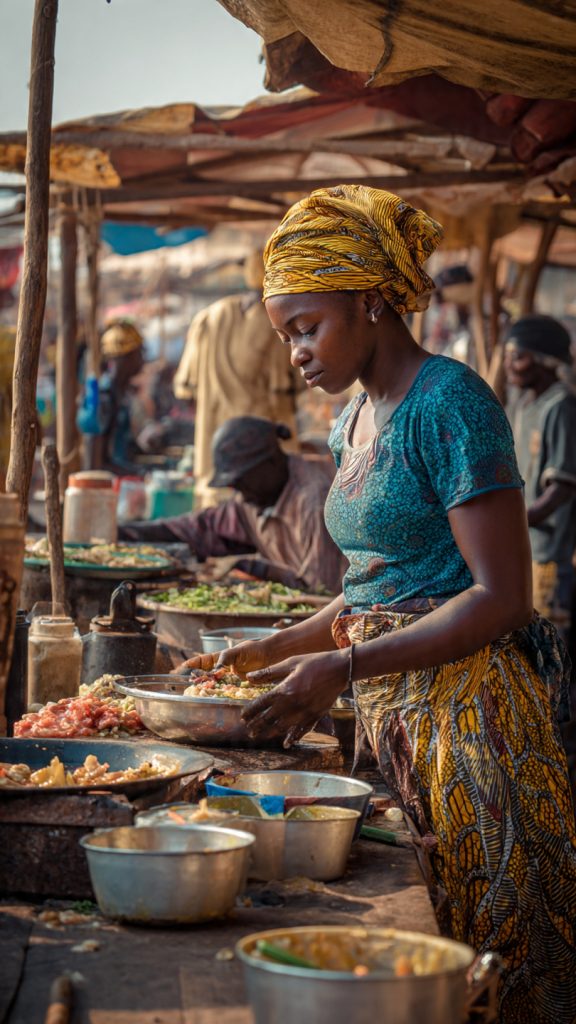
Informal Food Sector and Migrant Nutrition in South Africa
Opening: A Migrant Family’s Sunday Question
In a low‑income township on the outskirts of Johannesburg, a Congolese migrant mother named “Aisha” stands outside a small corner shop — a spaza — holding hands with her two children. With limited income and no reliable transport, she cannot afford a full weekly shop at a formal supermarket. Instead, she visits the spaza just 200 metres from her backyard rental each evening to buy a small quantity of maize meal, some instant noodles, a litre of milk, and a piece of fruit. For many migrants like Aisha, this spaza isn’t just a convenience — it is vital.
Recent research confirms that the informal food sector — spaza shops, street vendors, informal markets — remains a central pillar of food access and nutrition for low-income urban households in South Africa, especially among migrant communities. journals.ukzn.ac.za+2MiFOOD Network+2
As economic pressures mount and formal employment remains precarious, informal traders also provide livelihoods for many migrants themselves. Recognising this dual role is essential for designing inclusive, equitable food and health policies.
This blog post explores how the informal food sector supports (and sometimes undermines) the nutritional needs of African migrants. It draws on empirical evidence (2020–2025), real-world examples, and policy analysis to offer actionable recommendations for stakeholders.
The Informal Food Sector: Definition and Scale
-
What is “informal food sector”?
This includes small unregistered or semi-registered enterprises such as spaza shops (corner/household-run grocery stores), street vendors, hawkers, bakkie traders, small “tuck shops,” and informal markets selling groceries, fresh produce, or ready-to-eat meals. southernafricafoodlab.org+2africancentreforcities.net+2 -
Scale and economic importance
-
An estimated 150,000 such informal outlets serve over 11 million people across South Africa. Business Day+1
-
The informal fast-moving consumer goods (FMCG) retail market — including spaza shops — was valued at roughly R197 billion in 2023. Business Day
-
Some estimates place the informal food economy at between R276 billion and R376 billion per year, contributing substantially to national retail trade. Financial Mail+1
-
Surveys from the Migration & Food Security Network (MiFOOD) show migrants commonly rely on informal sources: in one recent survey, among African migrants and refugees, 52% bought food from spazas and 52% from street vendors — nearly matching reliance on supermarkets (79%). MiFOOD Network
-
Thus, the informal food sector is not marginal — it is a core pillar of food systems, especially in urban townships and settlements where many migrants live.
Why Informal Food Access Matters for Migrants
1. Proximity and Accessibility
-
Informal retailers are often embedded in townships, informal settlements, and low-income neighbourhoods. They are located within walking distance of homes, near transport hubs (taxi ranks, bus stops), or along pedestrian routes — making them accessible even for those without private transport. africancentreforcities.net+2Bhekisisa+2
-
For migrants lacking stable income, transport, or time, proximity reduces travel cost (money and time) and enables daily or frequent small purchases, which formal supermarkets — often farther away and requiring bulk buying — may not allow. Farmer’s Weekly SA+2SpringerLink+2
-
Informal shops often allow purchase in small quantities (“breaking bulk”), which is more feasible for cash‑strapped households. africancentreforcities.net+1
Thus, informal food outlets lower structural barriers to food access — a critical advantage for migrant households often living precariously.
2. Affordability and Flexibility
-
Informal outlets often offer lower-cost or flexible-purchase options. For example, a migrant interviewed in a 2023 MiFOOD survey noted that because of rising food prices, she now buys smaller portions more frequently — often purchasing only what she can afford that day. MiFOOD Network+1
-
Spaza shops and street vendors may sell staple foods (maize meal, bread, milk), processed/commercially preserved foods, and sometimes fresh produce — though availability varies. AJFAND+2Centre of Excellence+2
-
For households without refrigeration or stable electricity — common in informal settlements and backyard rentals — the ability to buy small amounts of perishable food daily or frequently is essential. africancentreforcities.net+2SpringerLink+2
In short: informal food outlets provide a flexible, low-entry-cost food supply that matches the economic constraints of migrant households.
3. Livelihoods for Migrants Themselves
-
Many informal food outlets are owned and operated by migrants themselves. These enterprises provide an important income source in a context of limited formal-sector opportunities. MiFOOD Network+2Bhekisisa+2
-
Informal food traders, particularly women and foreign nationals, are disproportionately vulnerable yet often excluded from formal safety nets or institutional support. A 2022 report from the Human Sciences Research Council (HSRC) highlighted how women informal food traders were hit hardest by economic shocks during COVID‑19, and yet received the least assistance. HSRC
-
For migrant families, owning a spaza or informal food business can mean not just subsistence — but a stepping stone toward social and economic stability in a new environment.
Thus, the informal food sector does not only supply food — it also underpins livelihoods, social inclusion, and economic adaptation for migrant communities.
Nutritional Implications: Opportunities and Challenges
While the informal sector clearly supports food access, its impact on nutrition is mixed and depends on several inter-related factors.
✔️ Potential Contributions to Nutritional Security
-
A qualitative study in the township of Duncan (in the municipality of Buffalo City Municipality) found that informal markets and food vendors served as a “food source, a food kitchen, and even a cookstove/refrigerator” for households without proper infrastructure. journals.ukzn.ac.za
-
Research on fresh-produce street traders during the COVID-19 period concluded that they played an essential role in making fruits and vegetables accessible to low-income residents, thereby supporting dietary diversity and food security. SpringerLink+1
-
In contexts where formal supermarkets are far and transport is costly or unreliable, informal food vendors provide more consistent and accessible food supply — a foundational precondition for nutritional well‑being.
⚠️ Limitations: Nutrient Quality, Variety, and Vulnerabilities
-
Many spaza shops and informal retailers heavily stock staple foods, processed foods, and ultra-processed items. Fresh produce remains scarce in many shops because of limited storage, poor refrigeration, and logistical constraints. Centre of Excellence+2AJFAND+2
-
A nutrition‑oriented study found that many battered, processed, or convenience foods dominate the inventories of informal shops, contributing to poor diet quality when these outlets are a primary source for households. Centre of Excellence+1
-
Vendors — especially those selling indigenous crops or fresh produce — face severe vulnerabilities from climate shocks, crop perishability, lack of cold storage, and infrastructural marginalisation. For example, a 2025 study of indigenous crop vendors in Durban found that 88% of vendors experienced income loss during floods, 71% during COVID-19 disruptions, and 68% during civil unrest. PubMed
-
Policy and municipal frameworks often exclude or marginalise informal food traders. During the first COVID‑19 lockdown, only formally registered or “South African-owned” spazas were allowed to operate — many migrant‑owned shops were forced to close. MiFOOD Network+1
-
Traders report difficulties obtaining permits; frequent harassment by local authorities; unpredictable regulations; and limited access to institutional support, financing, or infrastructure — all of which undermine the resilience and sustainability of informal food supply. MiFOOD Network+2SpringerLink+2
In short: while the informal food sector provides vital access to food, migrant households relying heavily on it may face tradeoffs in nutritional quality, dietary diversity, and long-term food security — especially under systemic stress.
Intersectional Realities: Gender, Migration Status, Housing, and Age
To understand the role of informal food systems for migrants, one must consider intersectional factors:
-
Gender and migration status: Many informal food traders are women and migrants — a strong but vulnerable economic group. The HSRC found that women informal food traders suffered significantly during economic downturns and received minimal state support. HSRC+1
-
Housing and infrastructure constraints: Migrants often live in backyard shacks, informal settlements, or overcrowded rentals without refrigeration or stable electricity. This limits their capacity to store perishable foods, making small and frequent purchases from informal vendors the only feasible route. africancentreforcities.net+2SpringerLink+2
-
Income and employment precarity: Many migrants work informal or casual jobs, with irregular income — especially recently amidst inflation, economic contraction, and rising unemployment. This drives reliance on low‑cost informal food outlets.
-
Age, household composition, and remittances: Some migrant households include dependents (children, elderly relatives) or send money to families elsewhere. This constrains budgets further, making flexible informal food buying crucial.
Thus, the intersection of migration, gender, low-income housing, and informal employment shapes a distinct nutritional vulnerability — with the informal food sector often acting as the only available buffer.
Real-world (Anonymised) Examples from Migrant Lives
-
“Amina” — single mother, Zimbabwean origin, Johannesburg backyard rental
-
She works as a domestic worker for irregular hours. With fluctuating daily pay and limited transport, she shops daily at a spaza close to her home. She buys small amounts — maize meal, instant noodles, and a litre of milk — and occasionally second-hand frozen vegetables when available. She reports that this helps her stretch her meagre income across the month, though fresh produce is rare.
-
-
“Family of four” — DRC-origin, living in a township near Cape Town
-
During COVID-19 lockdowns, their usual access to supermarkets was disrupted. They depended on a local street vendor for vegetables and on a migrant-run spaza for staples. The vendor sold leafy greens, carrots, and some fruit — making up nearly half their vegetable consumption. When the vendor temporarily stopped trading (lockdown, transport issues), the family experienced episodes of food shortage, especially of fresh foods.
-
-
“Vendor X” — female migrant vendor in Durban (indigenous vegetables and crops)
-
She sells leafy vegetables and traditional crops at an early‑morning market near her home. During the 2022 floods and later lockdowns, she lost much of her stock due to perishability and lack of refrigeration — income dropped by over 70%. She struggled to restock because of transport and market disruptions. This knock‑on effect reduced supply of fresh vegetables in her community, pushing households toward more processed foods.
-
These examples illustrate how informal food systems can both support and fail migrants depending on structural context, shocks, and policy environment.
Policy Gaps and Structural Barriers
Despite its critical role, the informal food sector remains largely marginalised in formal policy and planning. Key gaps include:
-
Lack of formal recognition and integration. Many municipal and urban planning frameworks treat informal trading as “temporary” or “illegal,” failing to recognise its permanence and role in food security. Frontiers+2africancentreforcities.net+2
-
Regulatory barriers and permit systems. Traders — especially migrants — face burdensome permit requirements, lack of clarity, exclusionary practices (e.g., preferential treatment for South Africans), and harassment by authority (police, municipal officers). MiFOOD Network+2journals.ukzn.ac.za+2
-
No institutional support or inclusion in food security planning. Despite representing a large share of food supply in townships, informal traders seldom receive support (financial, infrastructural, training), even during crises such as COVID-19. Centre of Excellence+2HSRC+2
-
Infrastructure deficits. Lack of cold storage, access to wholesale supply chains, transport, and stable utilities limit the capacity of informal vendors to provide fresh, nutritious food. PubMed+2Centre of Excellence+2
-
Nutrition quality concerns. Given constraints, informal outlets often stock cheap, ultra-processed foods over fresh produce, undermining dietary diversity and long-term health. Centre of Excellence+2AJFAND+2
In sum: while informal food systems offer critical access, systemic neglect and structural barriers constrain their potential to fully meet nutritional needs — particularly for vulnerable migrant populations.
What We Know — and What Remains Under‑researched
Established evidence:
-
Informal food outlets remain a major source of food for low-income urban residents, including migrants. journals.ukzn.ac.za+2MiFOOD Network+2
-
These outlets provide flexible, small-quantity purchases, often nearer to homes than supermarkets. africancentreforcities.net+2journals.ukzn.ac.za+2
-
Informal food trade also supplies livelihoods, particularly for migrants and women. Business Day+2MiFOOD Network+2
-
External shocks — climate events, pandemics, civil unrest — hit informal food vendors hard, revealing deep structural fragility. PubMed+2Frontiers+2
Gaps/under-researched areas:
-
There is limited empirical data on the dietary quality and nutritional outcomes specifically among migrant households reliant on informal food. Few studies disaggregate by nationality, documentation status, gender, age, or household composition.
-
There is scant longitudinal research: how does long-term reliance on informal food affect chronic disease risk (e.g., micronutrient deficiencies, non‑communicable diseases) among migrants?
-
Few evaluations exist of interventions aiming to strengthen informal food supply for improved nutrition (e.g., supporting fresh produce trade, integrating informal vendors into urban planning, improving storage/transport infrastructure).
-
Limited research on policy barriers from migrants’ perspectives: what bureaucratic, xenophobic, or structural obstacles do migrant traders face in different municipalities?
Addressing these gaps will require interdisciplinary research (nutrition science, urban planning, migration studies), disaggregated data collection, and participatory methods involving migrant communities themselves.
Promising Innovations and Community‑Led Initiatives
Despite challenges, there are emerging initiatives and examples that point to how the informal food sector can be leveraged to improve migrant food security and nutrition:
-
The 2024 study of informal markets in Buffalo City showed that households without formal infrastructure used informal markets not just to buy groceries, but as their daily “kitchen” — buying ready-to-eat meals or prepared foods when cooking facilities or utilities were absent. journals.ukzn.ac.za
-
Some municipalities and civil society actors (post‑lockdown) have started reconsidering urban planning: allowing street vendors near taxi ranks, bus depots, and integrating informal traders into local food supply — acknowledging their role in keeping townships fed. News24+1
-
Emerging digital technology adoption: in 2024, the informal retail sector reportedly saw rising e‑commerce, with some spaza shoppers ordering goods via platforms such as WhatsApp or delivery services — a trend that could reduce transport barriers for vulnerable households. Business Day+1
-
Growing recognition by think tanks and advocacy networks (e.g., MiFOOD, urban food security networks) that informal food systems are not just survival‑mechanisms, but vital urban food infrastructure deserving policy support. MiFOOD Network+1
These examples hint at a path forward: one in which informal food systems are stabilized, supported, and woven into urban food security strategies — rather than being treated as temporary or illegal.
Recommendations: Towards an Inclusive, Migrant‑Sensitive Urban Food Policy
Given the evidence and the gaps, here are concrete, actionable recommendations for stakeholders (government — national, provincial, municipal; NGOs; community organisations; researchers).
| Stakeholder | Recommendation | Implementation Timeline (2026–2028) |
|---|---|---|
| Municipal & Local Government | Recognise and formally integrate informal food traders into urban food planning. Grant trading permits that do not discriminate by nationality. | 12 months — revise municipal by-laws; establish clear, inclusive permit procedures. |
| Provide micro‑infrastructure support (e.g., access to cold storage, clean water, waste disposal) in targeted low-income townships/backyard rental zones. | 18–24 months — pilot in 3–5 high-migrant neighbourhoods (e.g., in Johannesburg, Cape Town, Durban). | |
| Public Health & Food Safety Departments | Develop and deploy nutrition-sensitive food safety training for informal traders, including migrant vendors; support safe storage and handling of fresh produce. | 6–12 months — partner with NGOs for training modules; deploy certificates of compliance. |
| NGOs / Migrant-led Organisations | Form “informal food vendor cooperatives” to support bulk procurement (wholesale access), shared storage, and mutual aid — improving supply of affordable, fresh produce. | 12–18 months — map interested vendors; initiate cooperative formation; pilot bulk purchase programme. |
| Donors / Development Agencies | Fund research on migrant dietary outcomes, food environment mapping, and interventions to improve diet diversity among informal-sector–dependent households. | 24 months — issue calls for proposals; fund 2–3 longitudinal studies. |
| Academia & Researchers | Conduct mixed-methods research combining nutrition assessment, migration history, socio-economic data, and food access patterns — disaggregated by nationality, documentation status, gender, age. | Ongoing (from 2026) — include in research agendas; publish disaggregated data. |
If implemented, these recommendations can transform the informal food sector from a survival mechanism into a resilient, inclusive pillar of urban food systems — benefiting migrants and long-term residents alike.
Conclusion: Recognising the Informal Food Sector as a Public Health Asset
For many African migrants living in South African townships, backyard shacks or informal rental housing, the informal food sector is not a stopgap — it is a lifeline. Spaza shops, street vendors, and informal markets supply staple foods, flexible purchasing, and livelihoods. Yet systemic neglect, poor infrastructure, and regulatory barriers undercut their capacity to deliver nutritious diets or provide stable incomes.
Policymakers, public health actors, and researchers must reframe the informal food sector as an essential component of urban food systems. This means supporting it — through inclusive regulation, infrastructure, training, research, and community-led innovation.
Failing to do so will perpetuate nutritional insecurity and health inequities among migrants — undermining broader goals of public health, social inclusion, and urban resilience.
Call to action: Municipal governments should begin revising by-laws to support inclusive trading permits immediately. NGOs and migrant‑led organisations should mobilise cooperatives for bulk procurement. Researchers should prioritise longitudinal studies on nutrition in informal-food‑dependent households. Only through coordinated action can the informal food sector become a stable, equitable, and nutrition‑supporting infrastructure for all.
Recent Posts:
- How Does Xenophobia Impact the Food Security and Livelihood Strategies of African Migrant Food Vendors in South African Informal Economies?
- What Are the Barriers to Healthcare Access for Diet-Related Non-Communicable Diseases Among Undocumented African Migrants?
- How Do Transnational Food Networks Shape Food Sovereignty and Cultural Identity for African Migrant Communities?
- What Is the Relationship Between Migration Status and Nutritional Transition Among African Migrants in Urban South Africa?
- How Does Food Insecurity Among African Migrants in South Africa Compare to Host Popu