
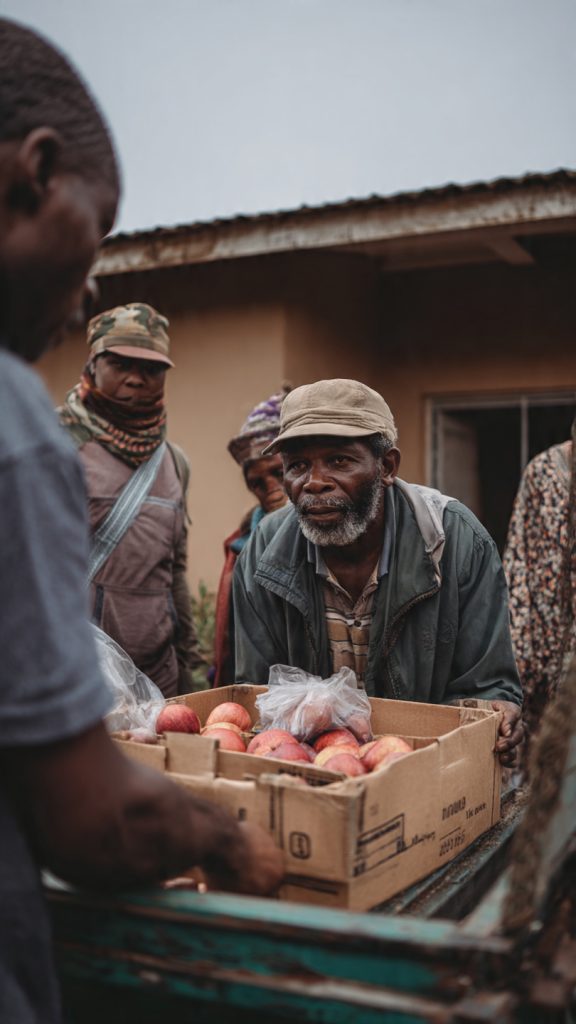
Are Migrants in South Africa Being Reached by Food Assistance?
In 2021, at a food-parcel distribution event in Jeppestown, Johannesburg, around 400 immigrants — many registered to receive aid from the provincial government — were turned away, even though the distribution truck still had food. It left full. Meanwhile, dozens of South African families were handed parcels on the spot. GroundUp News
That incident was not an isolated outlier. It illustrated a deeper structural failure: despite lofty claims about food relief programmes, many foreign nationals remain effectively excluded. In a country where millions already struggle with food insecurity, this failure compounds vulnerability among refugees, asylum-seekers, and undocumented migrants.
Recent research confirms what lived experience has long suggested: food aid systems in South Africa routinely miss or marginalize migrant communities — often precisely those with the greatest need. PubMed+2ScienceDirect+2
Given South Africa’s history of migration and its constitutional commitments, this is more than a humanitarian oversight. It represents a serious rights-based and public-health challenge. With rising food inflation, declining incomes in informal work, and persistent xenophobia, an effective, inclusive food strategy is urgent.
Overview of South Africa’s Food Assistance Landscape
What exists now — government, civil society, and refugee-focused aid
-
The main public actor remains the Gauteng Department of Social Development (GDSD) for provincial food-bank and parcel distribution. In many provinces, provincial social development departments worked with non-profits (NPOs) and food-banks to deliver parcels. GTA College+2UCT News+2
-
During the COVID-19 pandemic, a mixed-methods study covering August 2020 to January 2021 showed increased reliance on food aid — but aid providers, both state and civil society, could not meet demand. Recipients reported low access and poor nutritional and cultural alignment of parcels. Many expressed a preference for vouchers or cash rather than fixed parcels. PubMed+1
-
For migrants, especially refugees and asylum-seekers, the United Nations High Commissioner for Refugees (UNHCR) — via its local office, UNHCR South Africa Representation & Multi‑Country Office (SAMCO) — plays an important role. The 2024 SAMCO fact sheet reports in-kind food support and other core relief items provided to new arrivals. UNHCR+1
-
Some civil-society organisations go further. For example, the non-profit Operation Hunger — active nationwide — promotes sustainable livelihoods over short-term relief, focusing on income generation, agro-ecological production, and community-based food access. Operation Hunger
Thus, the assistance landscape is a patchwork of provincial social-development departments, NGOs/NPOs, and international agencies.
Why Migrants Often Fall Through the Cracks
Policy gaps and eligibility barriers
-
First, many official state relief programmes restrict eligibility by citizenship or documentation status. According to a policy audit, migrants — including asylum-seekers and refugees — were often excluded from COVID-era relief such as the Social Relief of Distress (SRD) grant. MiFOOD Network+1
-
Even where nominal access exists (for example via food-banks), practical barriers remain. Distribution often depends on static databases or pre-registration — and migrants may lack documentation, stable addresses, or awareness of application procedures. The 2021 Jeppestown example is a vivid illustration: even “registered” persons were turned away. GroundUp News
-
Moreover, the contents of food parcels often fail to reflect the nutritional, cultural, or household needs of diverse migrant communities. The 2025 mixed-methods study found that many recipients felt parcels were poorly matched to their diets. PubMed+1
-
Finally, structural changes within social-development departments have undermined reliable distribution. For instance, as of 2025, the GDSD collapsed its network of 288 NPO-run food-banks in favour of a single centralized food bank — a move critics warned would reduce access and increase marginalization. Gauteng+2Politicsweb+2
Implementation challenges: funding, supply chain, and capacity
-
Funding delays repeatedly disrupted food distribution. In mid-2024, major food banks in Johannesburg — including one run by the Believers Care Society — closed after the GDSD failed to pay for distribution costs. The food bank had been delivering ~5,000 parcels per month. The Mail & Guardian+1
-
Elsewhere, food parcels reportedly piled up in warehouses, unused — even as people went hungry. In one case, contracts had been awarded by the department, but the food banks lacked operational funds to distribute the parcels. GroundUp News+1
-
The 2025 GDSD quarterly report revealed underperformance: a target of 53,025 parcels fell short, with only 34,114 delivered. Similarly, a first-quarter target of 434,595 “pro-poor basket interventions” recorded nil delivery, blaming “supply-chain delays.” Gauteng
These gaps and failures disproportionately harm migrants, given their precarious economic and social status.
Migrant-Specific Vulnerabilities: Empirical Evidence
Informal economy collapse, job loss and food insecurity
Many migrants in South Africa work in the informal sector — perishable-trade, small-scale retail, casual labour, services — with little protection or stability. Research shows Covid-19 lockdowns hit these livelihoods hard: in a 2024 study, 83 % of migrants surveyed in informal food enterprises reported severe income loss. ScienceDirect
A parallel 2025 national-level analysis found food security, employment and welfare among migrant communities deteriorated significantly during and after the pandemic. Taylor & Francis Online
For migrants, loss of income does not just mean reduced food buying power: it also cuts access to informal food supply lines, social networks, and ability to move around the city — all vital for survival.
Rural–urban intersection, remittances, and coping
Although much attention focuses on urban migrants, rural–urban links remain important. For example, a longitudinal study in rural Bushbuckridge, Mpumalanga (2019 vs 2021) found that while off-farm employment declined during COVID, households buffered food insecurity by increasing subsistence agriculture, wild food use, and relying on migrant remittances. SpringerLink
This dynamic has gendered and intergenerational implications: remittance-dependent households — often headed by women, children or elderly — may face food stress if migrant family members lose income.
Yet state food-aid strategies rarely account for these translocal, remittance-linked households.
Refugees and asylum-seekers: modest coverage via humanitarian agencies
According to the 2024–2025 data from UNHCR’s South Africa MCO, the agency provided food and core relief items to some newly arrived refugees and asylum-seekers. UNHCR+1
Moreover, the recent 2025 report “Sustainable Responses for Refugees in Southern Africa” highlights progress in refugee inclusion — but also emphasises that support remains dependent on donor funding and remains insufficient relative to need. UNHCR+1
Thus, while humanitarian agencies provide a vital lifeline, their coverage remains partial and often temporary — which means long-term food insecurity persists for many migrants.
Intersectional and Rights-Based Dimensions
When evaluating the effectiveness of food assistance programmes for migrants, we must consider intersectional factors: gender, age, nationality, documentation status, and employment sector.
-
Gender: Women migrants often shoulder heavy caregiving burdens and may rely on informal trade or domestic work. Loss of income — as during COVID — disproportionately affects them. Taylor & Francis Online+1
-
Age: Elderly migrants or children in refugee households may suffer more from poor nutrition, especially when food parcels lack dietary diversity or culturally appropriate foods.
-
Documentation status: Undocumented migrants face systemic exclusion from social assistance; even asylum seekers may struggle if distribution systems require formal IDs or documentation. Reports document SRD grants and food aid exclusion for many non-citizens. MiFOOD Network+1
-
Informal economy workers: Migrants working in informal sectors lacked social protection during pandemic-related lockdowns, worsening food insecurity. ScienceDirect+1
From a rights-based perspective, this exclusion contravenes the principle of the right to food, enshrined in both national and international human rights frameworks. Given South Africa’s history, commitment to non-discrimination, and to humanitarian obligations through ratified treaties, the marginalization of migrants is deeply concerning.
Why Current Programmes Fail to Reach Migrants — Key Structural Failures
-
Centralization of distribution undermines access. The GDSD’s 2025 shift to a single central food bank has dramatically reduced accessibility for vulnerable populations. Distance, transportation costs, time constraints, and potential discrimination at the point of distribution all pose barriers — especially for migrants. Gauteng+2UCT News+2
-
Funding delays and mismanagement. Even where food parcels exist, distribution often stalls because departments fail to release funds. Food rots in warehouses while people go hungry. GroundUp News+2The Mail & Guardian+2
-
Eligibility criteria exclude non-citizens or impose impractical documentation requirements. Programs like the SRD grant and some food bank lists effectively exclude asylum-seekers, refugees, or undocumented migrants. MiFOOD Network+1
-
Parcel contents are nutritionally and culturally inadequate. Fixed food parcels seldom reflect the diverse diets of migrants. The 2025 mixed methods study found many recipients rejected parcels because of poor nutritional/cultural fit. PubMed+1
-
Over-reliance on civil society and humanitarian agencies for migrant support. Humanitarian actors like UNHCR provide important stop-gaps, but their scope is limited, temporary, and donor-dependent. This leaves many migrants in chronic insecurity. UNHCR+1
These structural failures disproportionately harm migrants, undermining both their right to adequate food and their health status — which in turn has broader public-health implications (malnutrition, mental health stress, increased vulnerability to infectious and chronic diseases).
Examples from the Ground — Anonymized Vignettes
Here are two anonymized, composite vignettes based on documented cases and interviews.
-
“Z.”, a Zimbabwean informal trader living in downtown Johannesburg with two children and a frail elderly mother. During the 2021 distribution in Jeppestown, Z. and her mother — despite being registered — were turned away. The truck left full. Z. said: “I asked why. They said foreigners must wait — but they handed food to South Africans standing behind me … My children cried.” GroundUp News
-
“A.”, a Congolese asylum seeker who arrived in South Africa in late 2023. He managed to register with UNHCR and got a food parcel. But six months later, UNHCR support ended, and he applied to the provincial food bank. He was told to produce a South African ID or proof of permanent residence — which he cannot. For months, he and other family members skipped meals, relying on friends — sometimes illegal trading — for food.
These examples show that even when migrants are visible in relief registers, bureaucratic, logistical, and discriminatory barriers often block access.
Innovative or Promising Alternatives — Some Rays of Hope
Despite the bleak picture, a few initiatives point toward more inclusive, sustainable approaches.
-
Humanitarian-led inclusion through UNHCR / SAMCO. The 2024–2025 SAMCO Annual Report indicates that UNHCR has increased efforts to include refugees and asylum seekers in social-assistance schemes — not only emergency food parcels, but also livelihood programmes, protection, and inclusion efforts. UNHCR+1
-
Community-led and livelihood-oriented models via NGOs like Operation Hunger. Rather than just distributing food parcels, these programmes focus on income generation, local production, agroecology, and community markets — offering migrants (and other vulnerable groups) a pathway toward long-term food security, dignity, and resilience. Operation Hunger
-
Calls for more flexible support: vouchers or cash over fixed parcels. Research on COVID-era food aid found that many recipients — especially women living with HIV — preferred vouchers or cash assistance rather than fixed parcels, which were often inadequate or culturally inappropriate. PubMed+1
These models distinguish themselves by emphasizing dignity, flexibility, inclusion, and economic empowerment — rather than paternalistic, one-off distribution.
Key Recommendations — Toward Inclusive, Rights-Based Food Policy for Migrants
Based on the evidence and gaps outlined above, I recommend the following actions for policymakers, practitioners, NGOs, and researchers:
1. Reform food assistance to ensure inclusion of migrants
-
Amend provincial food-aid eligibility criteria to explicitly include refugees, asylum-seekers, and undocumented migrants, regardless of formal documentation status.
-
Adopt “last-mile” distribution decentralisation. Reverse the 2025 centralisation strategy by the GDSD — re-empower NPO-run food banks or community-based distribution points to reach vulnerable groups. Implement within 6 months.
-
Use flexible aid modalities (food vouchers or cash transfers) rather than fixed food parcels to match dietary, cultural, and household needs. Pilot in Gauteng and one other major migrant-destination province in the next 12 months, then scale up.
2. Strengthen funding, supply-chain transparency, and accountability
-
Ensure that funds for distribution (not just parcel supply) are disbursed on time. Set strict service-level agreements (SLAs) with food banks, with public reporting quarterly.
-
Establish a real-time monitoring and feedback mechanism, accessible to beneficiaries (including migrants), to flag discrimination, delays, or supply issues.
3. Support livelihood- and resilience-building programmes
-
Expand support for NGOs (e.g., Operation Hunger) that promote agroecology, community gardens, micro-enterprises, and livelihoods — including migrants, women, youth. Provide seed funding, training, and legal space for migrant participation.
-
Integrate migrants into broader food-security and nutrition programmes (e.g., school- or community-feeding programmes) — not just emergency aid.
4. Strengthen humanitarian-government collaboration with long-term commitment
-
Integrate efforts from humanitarian actors (e.g., UNHCR’s SAMCO) into national and provincial social-protection frameworks. Develop multi-year joint plans for inclusion of refugees and asylum-seekers.
-
Allocate specific government budget lines for migrant inclusion in food security and social-protection schemes.
5. Invest in research, data collection, and monitoring
-
Commission a national survey (or integrate into existing national household surveys) to estimate food insecurity levels among migrants, refugees, asylum seekers and undocumented persons. Include breakdown by gender, age, documentation status, employment, and urban/rural location.
-
Evaluate the nutritional and cultural adequacy of food parcels vs. vouchers or cash; assess health outcomes among migrant recipients over time.
-
Monitor impacts and unintended consequences (e.g., stigma, discrimination, xenophobia) of food-aid delivery.
Implications for Public Health, Migration Health and Social Justice
Failing to include migrants in food-assistance programmes does more than violate human rights. It undermines public health. Chronic food insecurity among migrants leads to malnutrition, weakened immunity, increased risk of infectious and non-communicable diseases. It places additional burden on already overstretched health services.
Moreover, exclusionary food policies deepen social inequalities, fuel xenophobia, and erode social cohesion. An inclusive, rights-based food strategy can help integrate migrants into society, reinforce social solidarity, and reduce health disparities.
Limitations and Research Gaps
-
There is surprisingly little up-to-date, nationally-representative data on food insecurity specifically among migrants (refugees, asylum-seekers, undocumented). Most evidence comes from small, localized studies, anecdotal reports, or humanitarian agency data.
-
Longitudinal data on the health effects of chronic food insecurity in migrant populations in South Africa is almost entirely absent.
-
There is insufficient analysis on the gendered dynamics of food insecurity among migrants (for example, single mothers, female-headed households, elderly dependents).
-
Finally, we lack robust evaluations of alternative aid modalities (vouchers, cash, livelihoods support) specifically for migrants in the South African context.
Addressing these gaps should be a priority for public health researchers and funders.
Conclusion — A Call to Action
The 2021 Jeppestown event — with registered immigrants turned away while food trucks went home full — should shame us. It should force us to confront not just logistical failure, but systemic exclusion.
Right now, South Africa’s food-assistance system fails many migrants — precisely the people for whom aid is most essential. That failure undermines public health, human dignity, and social justice.
But it does not have to stay this way. By embracing inclusive, flexible, and rights-based policy reforms — decentralised distribution, vouchers or cash, livelihood support, and migrant-sensitive inclusion — we can build a food-security system that works for everyone.
I call on:
-
Policymakers (national and provincial): to reform eligibility, reverse centralisation, and allocate dedicated budget lines for migrant inclusion.
-
NGOs and civil society: to scale up livelihood-oriented interventions and advocate for inclusive aid policies.
-
International agencies and funders: to sustain and expand support for migrants and refugees beyond emergency food aid.
-
Researchers and academics: to generate robust, disaggregated data on migrant food insecurity, and formally evaluate alternative aid models.
Let us move from episodic charity to systemic inclusion. Let us ensure that “food security for all” truly means all — citizens and migrants alike.
Only then can South Africa begin to live up to its constitutional promise of dignity, equality and the right to food.
Recent Posts:
- What Are the Long-Term Health Implications of Dietary Acculturation for Second-Generation African Migrants in South Africa?
- How Do Gender Dynamics Shape Food Access, Preparation, and Nutrition Outcomes Within African Migrant Households in South Africa?
- What Role Does the Informal Food Sector Play in Meeting the Nutritional Needs of African Migrant Populations?
- How Does Xenophobia Impact the Food Security and Livelihood Strategies of African Migrant Food Vendors in South African Informal Economies?
- What Are the Barriers to Healthcare Access for Diet-Related Non-Communicable Diseases Among Undocumented African Migrants?