
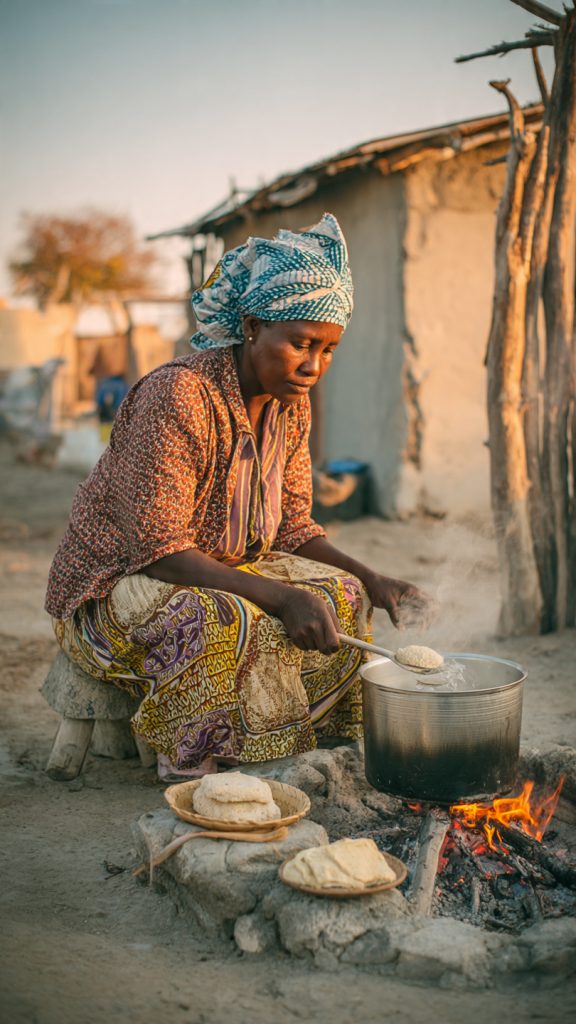
Climate, Displacement and Hunger: Why Migrants in South Africa Are on the Frontline
In 2023, a household survey in Gauteng found that migrant households in the region had markedly higher risk of food insecurity than native-born households — even after controlling for employment, household size, and other socioeconomic factors. Wiley Online Library
At the same time, climate change continues to erode South Africa’s agricultural capacity and destabilize food prices: recent estimates warn that without adaptation, by 2050 agricultural production could fall by up to 50%, threatening staple-food availability for the country’s poorest. Stellenbosch Business School+2Nature+2
For African migrants — both internal and cross-border — many of whom already live in precarious conditions, these twin trends (climate-driven food system disruption + structural vulnerability) combine to deepen hardship. In this context, we must ask: how are migrants’ livelihoods and food security being shaped by climate change, what strategies are they using to cope, and how should policy respond?
The Policy and Contextual Landscape: Where We Stand — and Where We Fall Short
South Africa’s food and climate policy background
-
The national South African Vulnerability Assessment Committee (SAVAC) now uses a food-security framework that blends quantitative and qualitative indicators, and documented that only 36.5% of households were fully food secure in its most recent national survey; the remainder experienced varying degrees of food insecurity — including 17.5% in severe food insecurity. Centre of Excellence+1
-
A survey conducted between 2021 and 2023 by the Human Sciences Research Council (HSRC) highlighted that urban food insecurity remains a massive challenge: in 2023, the report found that in the two most urbanised provinces, large numbers of households struggled to access adequate, nutritious food. SpringerLink+2Phys.org+2
-
At the same time, climate change’s impact on agriculture is growing. Recent modelling shows severe yield reductions for staple crops (maize, rice, soy etc.) under high-emissions scenarios — a signal that crop-based food security will be under increasing strain. Nature+2mdpi.com+2
-
Experts warn that unless South Africa transforms its food system — not just through production but improved urban-food access — the growing urban population may face worsening hunger. SpringerLink+2Journals+2
These findings show that structural food insecurity intersects with climate risk in ways that disproportionately affect poor and marginalized households. Migrants — especially those lacking documentation, with unstable incomes, or limited social capital — are likely among the hardest hit. Yet South African food/climate policies rarely mention migration specifically. This gap signals a critical blind spot.
Empirical Evidence: What We Know (and What We Don’t)
Food insecurity among migrants in Gauteng and other cities
A recent article, “Urban food insecurity and its determinants among migrant households in the Gauteng city-region”, used a Linear Probability Model to examine food insecurity risk among migrant households. The authors found that migrants were more vulnerable to food insecurity compared to non-migrants, even after accounting for standard socioeconomic controls. Wiley Online Library
At the national level, broader surveys echo the magnitude of the problem: in 2023, the national moderate-to-severe food insecurity rate rose to 19.7% (up from 15.8% in 2019); severe food insecurity increased to 8.0%. Statistics South Africa+1
In urban areas, the challenge is stark. According to a 2025 analysis of urban food systems, approximately 63% of urban households experienced food insecurity; among those, about 17% were critically undernourished. SpringerLink
In the province of Gauteng — home to a large share of national and international migrants — one recent report indicates that 37% experienced mild to moderate food insecurity in 2023, while 14% faced severe food insecurity. Human Sciences Research Council
This body of evidence confirms that food insecurity remains entrenched, and disproportionately affects urban, low-income, and likely migrant households.
Climate Change and Food System Disruptions: Magnifying Risk for Migrants
Agricultural decline and price volatility
Climate change is already hitting food production in South Africa. A 2022 study of rural communities in KwaZulu-Natal (e.g., the Somkhele area) documented declining agricultural yields, water scarcity, poor soil quality, livestock losses, and resulting hunger and livelihood loss — especially since about 2015. mdpi.com
More broadly, aggregate modelling shows that climate change (especially under high-emissions scenarios) will severely reduce yields of staple crops like maize across sub-Saharan Africa — reducing availability and pushing prices up. Nature+1
For urban migrants — largely dependent on purchasing rather than producing food — such disruptions translate into higher and more volatile food prices. According to one analysis, a 1% food-price increase reduces household welfare (ability to meet basic needs like food, healthcare, education) by more than 20%. Stellenbosch Business School+1
Systemic disruption to urban food supply systems
Urban food systems in South Africa are increasingly under stress. A 2025 study argues that much of the current policy discussion focuses on boosting production — but neglects the reality of urban food access, especially for marginalized households. SpringerLink+1
Rising food insecurity in urban areas reflects not just agricultural decline but systemic issues: lack of affordable transport, inadequate infrastructure, weak distribution networks, and limited social safety nets. These structural weaknesses often hit migrants harder, since they may lack social capital or formal employment.
Compounding the problem, climate-driven extreme events (droughts, erratic rainfall, floods) — which are becoming more common in South Africa — damage infrastructure, disrupt supply chains, and raise the cost of food delivery. Stellenbosch Business School+2mdpi.com+2
Real Stories: Migrants Navigating Food Insecurity (Anonymized Illustrations)
“Aisha,” a 34-year-old woman from the DRC, living in a crowded Johannesburg township.
She migrated two years ago, drawn by hopes of stable work. She works informal, part-time jobs, but income is unpredictable. Recently, she started buying cheaper maize meal and skipping veggies because prices skyrocketed after a poor national maize harvest. Her children now eat one meal a day — sometimes only maize and salt. She often wonders: “If maize gets more expensive, what will we eat?”
“Samuel,” internal migrant from Eastern Cape, living in Gauteng, male household head.
His household was part of a 2023 survey that found migrant families had higher food insecurity. Wiley Online Library He lost informal work after a local drought drove up transport and food prices. He now sends a family member back to Eastern Cape to seek seasonal farm work — but that option is shrinking under worsening climate patterns.
“Grace,” a 45-year-old South African citizen living in an informal settlement in Cape Town, with two grandchildren.
Though not an international migrant, she shares many vulnerabilities with migrant households (low income, unstable employment, high dependency ratio). A recent CSO-run community garden project allowed her to grow some vegetables. That small yield, though limited, gave nutritional diversity to her grandchildren — underscoring the potential of urban agriculture for vulnerable urban dwellers.
These stories highlight the diversity of migrant experiences — but also shared vulnerability: precarious incomes, dependence on cash for food, exposure to food-price shocks, and limited access to safety nets.
Where Policy Fails — and Why Migrants Fall Through the Cracks
-
Lack of migrant-specific food security policy. Despite mounting evidence of food insecurity among migrants, none of South Africa’s major food or climate policy frameworks (national or urban) explicitly target migrants or account for their unique vulnerabilities (documentation status, limited social capital, unstable incomes).
-
Overemphasis on rural agriculture and food production. National adaptation strategies and sustainability plans tend to focus on rural smallholder farmers and climate-smart agriculture. While important, they often ignore urban food demand and the challenge of access, particularly for migrants.
-
Weak social safety nets and informal employment volatility. Migrants often rely on informal, unstable employment. When climate or economic shocks hit, they lose income — and have few buffers. Current social grants and welfare systems are not designed for, or accessible to, many undocumented or recently arrived migrants.
-
Insufficient support for urban food systems and infrastructure. Food distribution infrastructure, local markets, community agriculture initiatives, and urban planning rarely integrate migrant communities. As a result, migrants face disproportionate barriers to affordable, nutritious food.
In short: climate change makes a bad situation worse — and existing policies do little to protect migrant households.
Promising Pathways: What Is Already Working — and What We Could Scale
Despite the challenges, some encouraging practices offer entry points for policy and programmatic intervention.
-
Community-based urban agriculture. A recent 2025 study of urban farmers in community gardens found that many households — including migrants and low-income urban residents — had improved food security and dietary diversity. Taylor & Francis Online+1
-
Social networks and local solidarity mechanisms. A 2025 analysis showed that, for many vulnerable urban residents, community ties and informal sharing networks function as critical survival strategies when formal systems fail. ScienceDirect
-
Reimagining urban food systems. Scholars argue for shifting policy — away from solely boosting agricultural output — toward transforming food access, markets, distribution, and social protection in urban areas. SpringerLink+2Centre of Excellence+2
-
Use of early warning and predictive models. On the continental scale, a new tool, HungerGist, offers promise: by monitoring media and unstructured data, it can identify early signals of looming food insecurity — especially useful in contexts with limited survey data. arXiv+1
These examples show that, even amid structural neglect, resilience can emerge through community action, innovation, and adaptive policy design.
What Needs to Happen — Key Recommendations (2026–2030)
| Stakeholder | Recommendation | Timeline / Key Actions |
|---|---|---|
| National government (DALRRD, Social Development, Home Affairs) | Develop a National Migrant Food Security and Resilience Strategy that explicitly includes migrants (internal and international), especially undocumented and informal sector workers. This should embed food security in migration policy frameworks. | 2026–2027: establish working group; 2028: draft strategy; 2029–2030: implement pilot interventions in Gauteng & Western Cape. |
| Municipal governments (cities: Johannesburg, Cape Town, eThekwini, etc.) | Incorporate urban food system resilience into city planning — support community gardens, local markets, subsidized urban agriculture, food distribution mapping. Prioritize wards/settlements with high migrant populations. | 2026: map food insecurity with migrant demographics; 2027–2028: allocate land for community gardens; 2029: launch food-access pilots. |
| NGOs and civil society | Strengthen community-based food support networks (foodbanks, community kitchens, migrant-friendly distribution), and collaborate with local authorities to ensure continuity. Document and evaluate these programs to build an evidence base. | Ongoing; expanded scale 2026–2028. |
| Academic / research institutions | Launch a longitudinal cohort study of migrant households’ food security, livelihoods, and health outcomes — disaggregated by nationality, gender, documentation status, and age. Also, assess climate change impacts on urban food access and market resilience. | 2026–2028: study design and baseline; 2029–2032: follow-up waves. |
| Donors and development agencies | Fund climate-resilience interventions in urban food systems — especially programs targeting migrants and other marginalized urban populations. | RFPs issued 2026; funding disbursed 2027–2029. |
Why This Matters — Intersectionality, Health, and Social Justice
Migrants are not a monolithic group. Gender, age, nationality, documentation status, and household composition (female-headed, children, elderly) all mediate how climate and food-system disruptions affect them. For instance: female-headed households historically face higher risk of food insecurity. Statistics South Africa+1
Moreover, food insecurity is not just a matter of hunger. It undermines health: malnutrition, increased risk of disease, poor child development, weakened immune systems, and mental health stress. Urban migrants lacking documentation may already face barriers to healthcare — compounding risks.
From a social justice angle, ignoring migrant food security breaches principles of equity and inclusion. Sustainable development and climate resilience must leave no one behind — including those who arrive seeking safety and opportunity.
Limitations and Research Gaps
-
Very limited data disaggregating by migration status, nationality or documentation status — most national surveys don’t capture such detail.
-
Few empirical studies link climate change directly to migrant food security outcomes in South Africa.
-
The existing urban agriculture research often excludes undocumented migrants or informal-settlement dwellers.
-
There is weak evaluation of how coping strategies (community gardens, foodbanks, informal networks) affect long-term nutrition, health, or livelihoods.
Thus, while the signal is clear — migrants are likely disproportionately affected — more focused empirical research is urgently needed.
Conclusion: A Call to Action
South Africa stands at a crossroads. Climate change and food system disruptions threaten to unravel decades of progress on poverty and food security. Urban migrants — drawn to cities in search of better lives — find themselves on the frontlines of this crisis.
Policymakers, city authorities, NGOs, researchers, and donors must act now. This requires shifting beyond traditional agriculture-centric climate adaptation. Instead, we must build inclusive, resilient urban food systems — systems that recognize migrants as part of the population, track their needs, and support their right to food, dignity and health.
Only through coordinated, migrant-inclusive policy and community engagement can we uphold the promise of a just, sustainable South Africa — one where no one suffers hunger because of where they were born or how they arrived.