
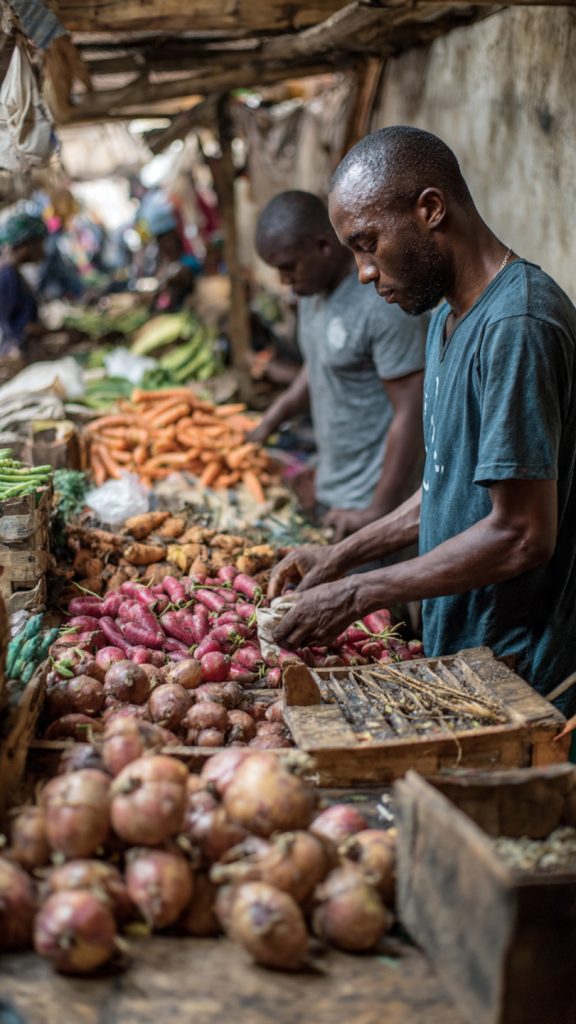
When networks become lifelines: a migrant household in Johannesburg
In 2024, a family of Mozambican migrants living in a township near Johannesburg spoke with researchers about their weekly food situation. They reported surviving on “what the group can afford together.” Neither parent had stable employment. Instead, they pooled income and shared staples bought in bulk by their migrant-led savings group. At times they relied on vegetables brought from rural Mozambique by a cousin. Without this solidarity network, the family said they would have faced hunger. This kind of informal social safety net — organized outside government or formal welfare — is increasingly common among migrants.
Recent data confirm such narratives. According to a 2025 study of Mozambican migrants in Johannesburg, only 10% of households were fully food secure, while 44% experienced high food insecurity and reduced dietary diversity. MiFOOD Network Meanwhile, a 2025 paper on migrant-led “solidarity associations” found that households belonging to these associations were three times more likely to report stable meals and diversified diets than non-members. Epubs+2SciELO+2
These findings suggest that in contexts where migrants are often excluded from formal welfare, social networks — ethnic associations, faith-based groups, mutual-aid savings clubs — serve as de facto food and health safety nets. But what does this mean for public health and policy? And how can South Africa leverage these networks to build more inclusive, resilient food systems?
How migrants are marginalized by formal food and social support systems
Exclusion from state support and formal food aid
The social safety nets and food-aid interventions deployed by government during crises such as the COVID-19 pandemic often failed to reach migrant populations. A 2025 study indicates that many migrants, especially those lacking documentation, were excluded from relief grants and food-parcel distribution. SpringerLink+2PubMed+2
Moreover, the pandemic disrupted informal food economies upon which many migrants depended. Informal food vendors (many of them migrants) saw their businesses shuttered completely due to lockdowns. A large-scale study found that three-quarters of migrant-run informal food enterprises suffered “intense pandemic precarity.” ScienceDirect+1 Without income, these households — and those that rely on their businesses for affordable food — faced sharply increased food insecurity. ScienceDirect+1
This reflects a broader structural problem: exclusion by design. To qualify for government relief, businesses often had to be formally registered. Migrant-owned spaza shops and informal food stalls — frequently unregistered — were systematically left out. PMC+1
Urbanisation, shifting diets, and loss of traditional food
Many migrants settle in dense urban areas such as Johannesburg, where they rely on markets — not subsistence agriculture — for food. HSRC+1 At the same time, migrants often value foods from their home countries. A 2023 study by the Human Sciences Research Council (HSRC) found strong demand among migrant households in Johannesburg for traditional leafy vegetables and fruits. But supply was inconsistent, prices high, and knowledge about where to source these foods was often limited. HSRC
Over time, dietary “acculturation” occurs: migrants substitute traditional, nutrient-rich foods with cheaper, more readily available processed or high-fat staples. This pattern echoes findings from refugee studies elsewhere in Africa. Migration+1 This shift increases risks not only of undernutrition but also of poor diet-related chronic diseases — a serious public health concern given the growing burden of non-communicable diseases (NCDs) in South Africa.
Structural and intersectional vulnerabilities
Several intersecting factors worsen migrants’ risk of food insecurity. Female-headed households, for instance, appear more likely to rely on solidarity associations and shared food systems. SciELO+1 Migrants with precarious documentation status often cannot access formal aid, legal work, or government grants. SpringerLink+2ScienceDirect+2 Young migrants, women, or those with chronic illnesses (NCDs, HIV, TB) face additional barriers in accessing adequate nutrition and healthcare support. Migration+2ScienceDirect+2
The result is a stratified landscape of vulnerability — shaped not just by migrant status but by gender, age, legal status, and socio-economic marginalization.
How social networks, ethnic associations, faith-based groups and mutual aid fill the gap
In the face of exclusion and structural barriers, migrants and communities have developed adaptive strategies to secure food and protect health. Research shows these strategies go beyond survival — they foster belonging, dignity, and resilience.
Migrant-led “solidarity associations”
The most striking evidence comes from a 2025 study of migrant-led associations in various Cape Town neighbourhoods (Parow Valley, Summer Greens, Kensington) and among Zimbabwean, Pakistani, and Cameroonian migrant communities. Epubs+1 These associations:
-
Run rotating savings and credit clubs, allowing members to pool funds and make bulk purchases of staple foods. Epubs+1
-
Facilitate food-sharing arrangements — not as charity, but as structured reciprocal exchanges rooted in trust. SciELO+1
-
Provide psychosocial support, a sense of belonging, and dignity — crucial when migrants feel excluded by state institutions. Epubs+1
Quantitatively, households in these associations were significantly more likely to report stable access to meals and a more diversified diet. Sihma+1
These associations act as informal, migrant-driven welfare systems — “social protection from below.” Epubs+1
Faith-based organisations and community food gardens
Faith-based organisations (FBOs) in South Africa have long played a role in social development, including food security, welfare, and community support. Leadership+1 During COVID-19, many churches and faith groups became first responders: distributing food parcels, running soup kitchens, offering shelter or temporary housing, and providing essential nutrition to vulnerable populations, including migrants. Centre of Excellence+1
Moreover, faith-linked initiatives are increasingly embracing sustainable, agroecological food systems. For example, the Southern African Faith Communities Environment Institute (SAFCEI) launched its “Faith Leaders Environmental Advocacy Training (FLEAT)” cohort in 2024. Faith and community leaders from multiple provinces committed to promoting agroecology, local food production, and food sovereignty as part of climate-justice and resilience efforts. SAFCEI+1
These efforts offer migrants — especially those with rural backgrounds — a means to reconnect with indigenous food systems, cultural eating patterns, and community identity. Community food gardens also build social connectedness, which is linked to mental health and overall well-being in migrant populations. MDPI+1
Mutual aid, informal support systems, and community-based initiatives
Beyond formal associations and faith-based groups, many urban poor communities — including mixed South African and migrant populations — rely on informal mutual aid networks. Research shows residents in low-income townships and informal settlements often share resources like food, water, and basic goods; help each other in times of crisis; and establish community-level coping mechanisms. ScienceDirect+1
In many cases, these informal systems are the only safety nets available — especially where state services are weak or absent. While these networks can never substitute for robust social protection, they offer critical relief and resilience in the face of economic precarity and structural neglect.
What’s missing — gaps in policy and evidence
Despite the clear role of community networks and informal solidarity in migrants’ food security and health, several big gaps remain.
Lack of formal recognition and support
Current national food security and social-protection policies in South Africa seldom recognise migrants — especially non-citizens or undocumented migrants — as beneficiaries. Relief schemes during COVID-19, for instance, often required formal documentation or business registration that many migrants could not provide. ScienceDirect+2SpringerLink+2
This exclusion creates a systemic barrier, pushing migrants into invisible, informal economies and forcing them to rely on community networks that lack institutional support.
Insufficient inclusion of migrant contexts in food & nutrition policies
Key national strategies and municipal food-security plans rarely specify how to address the needs of migrant communities, their dietary preferences, or the structural challenges they face (legal status, employment precarity, xenophobia). Even when migrants are present in large numbers — for example in cities like Johannesburg — food systems planning tends to treat the urban poor as a homogeneous group, without migrant-sensitive differentiation.
Limited data and research, especially post-2020
Although recent studies (2023–2025) provide valuable evidence, overall quantitative and longitudinal data remain scarce. We lack large-scale, nationally representative data on food security among different migrant subgroups (international vs. internal; documented vs. undocumented; by nationality, gender, age). We also know little about long-term health outcomes (nutrition-related illness, diet change, NCDs) or mental-health implications of food insecurity and social exclusion.
Moreover, there is limited documentation and evaluation of informal solidarity networks, faith-based gardens, or community-led food systems. Without this, it is hard for policymakers to know which community-based innovations are effective, scalable, or sustainable.
Early successes and promising models
Some recent initiatives show how migrant-sensitive, community-based approaches can improve food resilience and health outcomes.
-
The migrant-solidarity associations documented in the 2025 study offer a robust model of “social protection from below.” Their success in increasing food security suggests that such associations — when supported — can reduce dependence on emergency aid and create sustainable, dignified safety nets. Epubs+2SciELO+2
-
Faith-based agroecology initiatives by groups like SAFCEI show how indigenous food systems and climate-sensitive food production can provide culturally appropriate, nutritious food — while strengthening community bonds, identity, and ecological resilience. SAFCEI+1
-
Community gardens and urban farming — even on small plots — have proven successful elsewhere in enabling migrants (including refugees) to reconnect with agricultural practices, gain a sense of belonging, and improve dietary diversity. MDPI+1
These models suggest that combining social capital, local knowledge, and grassroots organising can create resilient food safety nets — especially for migrants excluded from formal systems.
Recommendations — building inclusive, migrant-sensitive food and health policy
Based on the evidence and gaps above, I propose the following actionable steps for different stakeholders.
For national and municipal policymakers (e.g., in Gauteng, Johannesburg, Cape Town)
-
Recognize migrants explicitly in food security and social protection frameworks
-
Amend social-assistance policies (e.g., food-aid schemes, emergency grants) to allow migrant households — including asylum seekers, refugees, undocumented migrants — to access support.
-
Where documentation is a barrier, develop alternative verification mechanisms (e.g., community-based certification, NGO/CSO endorsement).
Timeline: within next 12 months; pilot in high-migration urban municipalities (e.g., City of Johannesburg) within 18 months.
-
-
Support and partner with migrant-led associations and community food networks
-
Provide small grants, bulk-buy subsidies, or logistical support (e.g., access to communal storage, refrigerated transport) to migrant savings and food-sharing groups.
-
Recognise these associations as legitimate community stakeholders in municipal food-security plans.
Timeline: allocate budget lines in municipal food-security plans in next 1–2 fiscal cycles (2 yrs).
-
-
Integrate culturally appropriate and nutritious foods into public food-aid packages
-
Expand the definition of “acceptable food” in assistance programmes to include traditional African vegetables and staples.
-
Engage with migrant communities and traders to identify which traditional foods are most needed and how to source them sustainably (local procurement, cross-border trade, urban agriculture).
Timeline: pilot revised food-aid packages within 6–12 months; evaluate dietary diversity outcomes after 18–24 months.
-
-
Support agroecological and urban-farming initiatives
-
Allocate municipal land (vacant plots, community gardens) for community farming, especially in migrant-dense townships.
-
Provide resources (seeds, tools, training) and support networks for faith-based or community organizations that run gardens.
Timeline: map available municipal land within 6 months; launch pilot gardens in the following 6 months; scale up over 2–3 years.
-
For NGOs, community-based organisations and faith-based groups
-
Foster and formalise migrant-led solidarity networks
-
Encourage formation of rotating savings and credit associations (ROSCAs), bulk-buy buying groups, and shared community kitchens.
-
Document and evaluate these initiatives (membership, food security outcomes, cost savings, nutritional diversity) to build evidence for scale-up.
-
-
Promote agroecology and community gardening
-
Work with faith networks, local congregations, and migrants to establish community gardens.
-
Provide nutrition education that bridges migrants’ traditional diets and the realities of urban food systems.
-
-
Advocate for inclusive and migrant-sensitive food policy
-
Use evidence from grassroots initiatives and research to lobby municipal and national governments.
-
Build alliances between migrant-led associations, FBOs, local NGOs, and public-health advocates to amplify migrant voices in food-security planning.
-
For public health practitioners and researchers
-
Conduct longitudinal and disaggregated studies on food security, nutrition, and health outcomes among migrant subgroups — differentiating by nationality, documentation status, gender, age.
-
Evaluate community-based interventions (solidarity associations, community gardens, faith-based food aid) for effectiveness, scalability, sustainability, and impact on diet quality and health (e.g., NCDs, malnutrition, mental health).
-
Explore intersectional vulnerabilities — particularly how documentation status, gender, and employment precarity intersect to shape access to food, nutrition, and health services.
Limitations and research gaps
-
Existing empirical studies remain limited in scope and number. Most rely on small samples or case studies in particular neighborhoods or cities (e.g., Johannesburg, Cape Town). They may not capture the full diversity of migrant experiences across South Africa.
-
Many migrants remain “invisible” due to irregular status, fear of deportation, or stigmatization. This undercuts data collection and may skew findings toward better-connected or documented migrants.
-
There is little research linking migrant-driven food resilience directly with long-term health outcomes (e.g., NCD prevalence, child nutrition, mental health).
Addressing these gaps demands coordinated efforts from researchers, funders, governments, and community organisations.
A call to action
Migrant communities in South Africa are not passive recipients of poverty and exclusion. They build resilience through solidarity, shared resources, and communal innovation. As a public-health researcher with 15+ years’ experience in migration health, I argue it is time for policy to catch up.
-
Policy makers: include migrants explicitly in food security, social protection, and urban-planning frameworks.
-
NGOs and faith-based groups: support, formalise, and scale migrant-led food networks and community gardens.
-
Researchers: invest in rigorous, disaggregated, long-term studies to document health outcomes and intervention efficacy.
If we act now — with inclusion, respect, and solidarity — we can help transform these informal networks from survival strategies into sustainable pillars of food resilience, social cohesion, and public health.
Recent Posts:
- What Is the Impact of Climate Change and Food System Disruptions on African Migrant Livelihoods and Food Security in South Africa?
- How Effective Are Current South African Food Assistance Programs in Reaching and Supporting African Migrant Communities?
- What Are the Long-Term Health Implications of Dietary Acculturation for Second-Generation African Migrants in South Africa?
- How Do Gender Dynamics Shape Food Access, Preparation, and Nutrition Outcomes Within African Migrant Households in South Africa?
- What Role Does the Informal Food Sector Play in Meeting the Nutritional Needs of African Migrant Populations?