
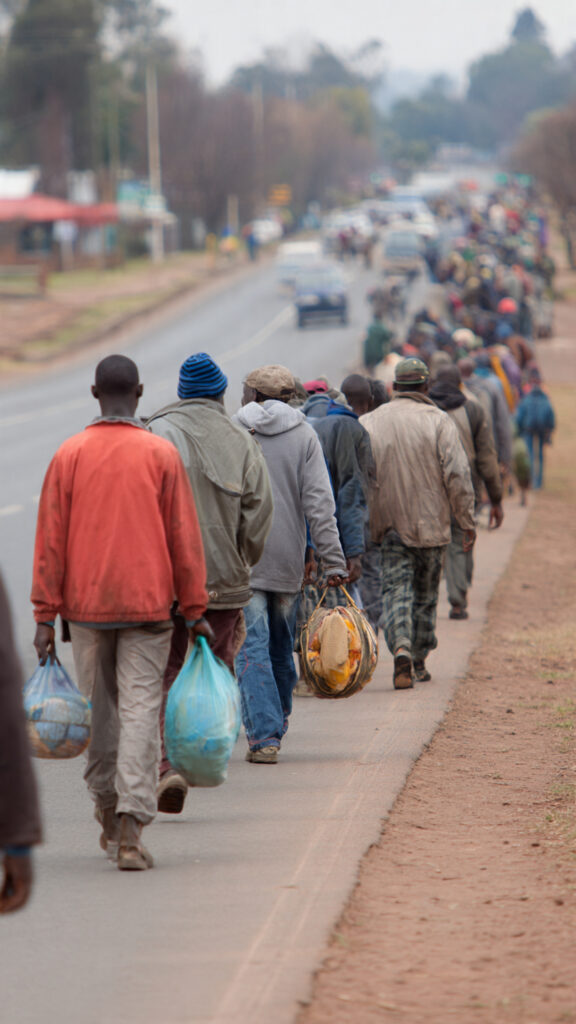
When Economic Inequality Drives Migration
In early 2023, a 28-year-old woman from Mzimba, northern Malawi, made the long journey to Johannesburg. She explained, “We had problems with food. We didn’t have enough to feed the whole family.” Her story, documented by the MiFOOD Network, reflects the difficult reality of many Malawians driven by food insecurity and unemployment.
At the same time, South Africa continues to stand as the economic powerhouse of the Southern African Development Community (SADC). Remarkably, over 58% of Malawi’s intra-regional imports come from South Africa, underscoring the deep structural asymmetry between the two economies. Consequently, these disparities reveal how regional integration—though designed to promote equality—can, paradoxically, sustain dependence and migration pressures if not implemented inclusively.
This blog explores whether regional integration frameworks can genuinely balance the economic inequalities that push Malawians to migrate south. From a public health perspective, understanding this relationship is critical because migration shaped by inequality has direct implications for disease patterns, healthcare access, and social determinants of health across both Malawi and South Africa.
Understanding the Regional Policy Context
SADC’s Integration Vision
The SADC Regional Indicative Strategic Development Plan (RISDP 2020–2030) outlines four core pillars: peace and security, industrialisation, infrastructure development, and human capital growth. Although the plan envisions inclusive prosperity, in practice, benefits remain unevenly distributed. More industrialised members—particularly South Africa—capture the lion’s share of trade and investment gains. Meanwhile, less developed countries, such as Malawi, often remain economically marginalised.
Recent analyses confirm this imbalance. For instance, the Political Economy Southern Africa (PESA) report (2023) found that smaller economies within SADC remain heavily dependent on South African imports, limiting their capacity to build local value chains. Consequently, migration becomes a coping mechanism to structural inequality rather than a policy failure of integration.
Health and Migration in South Africa
South Africa’s Constitution guarantees everyone the right to access healthcare services, regardless of nationality or legal status. In theory, migrants—documented or not—should receive free primary healthcare at public facilities. However, in practice, the implementation remains inconsistent. Research by the Health Systems Trust (2022) revealed that language barriers, documentation issues, and xenophobic attitudes often prevent migrants from receiving consistent and quality care.
Moreover, overcrowded health facilities in Johannesburg, Cape Town, and Durban exacerbate exclusionary practices. Despite constitutional protections, undocumented Malawian migrants frequently avoid clinics due to fear of deportation or discrimination. Therefore, delayed care and untreated illnesses—especially TB and HIV—remain widespread among migrant populations.
Malawi–South Africa Migration: Persistent Push and Pull Factors
Economic Realities in Malawi
Malawi continues to face persistent structural challenges, including low industrialisation, widespread unemployment, and heavy reliance on rain-fed agriculture. Food insecurity is widespread; approximately 15% of households experience chronic shortages. According to the ISS African Futures Report (2024), remittances now account for 1.3% of Malawi’s GDP, compared to just 0.2% a decade earlier. This increase underscores growing dependence on external labour markets.
Given the limited job opportunities at home, migration to South Africa appears both logical and necessary for survival. Indeed, many Malawian families depend on remittances to pay for school fees, food, and housing. Yet, this coping mechanism also exposes migrants to exploitation, poor health conditions, and emotional strain due to family separation.
Labour Demand in South Africa
South Africa’s informal economy continues to attract low-skilled labourers from neighbouring states. Malawians often find employment in domestic services, construction, and hospitality—sectors known for low pay, unsafe conditions, and minimal legal protection. In addition, irregular documentation heightens vulnerability to abuse and health exclusion. Consequently, the cycle of inequality persists: economic disparity fuels migration, and migration, in turn, sustains inequality.
Policy Gaps: Why Integration Hasn’t Solved Inequality
Unequal Distribution of Benefits
While regional integration has increased trade, it has not ensured fairness. South Africa dominates exports of manufactured goods, whereas Malawi remains largely an importer of finished products. Without industrial diversification or equitable trade mechanisms, integration reinforces dependency instead of reducing it.
Furthermore, most investment incentives within South Africa rarely extend to labour-sending countries. As a result, job creation in Malawi stagnates, perpetuating the conditions that encourage emigration.
Lack of Labour Market Integration
Although SADC prioritises economic and market integration, it has done little to harmonise labour mobility or social protection frameworks. The absence of legal labour pathways between Malawi and South Africa means that most migration remains irregular. Consequently, migrants are excluded from national labour rights, healthcare coverage, and pension schemes—leaving them exposed to exploitation and ill-health.
Health–Migration Disconnect
Health dimensions are frequently missing from regional economic policies. Yet, as highlighted by the WHO–South Africa Joint Agenda (2025), neglecting migrant health undermines the achievement of the Sustainable Development Goals. Migrant workers often live in overcrowded housing, lack preventive healthcare, and face disproportionate risks of infectious diseases. Despite these realities, few SADC frameworks explicitly promote health equity for mobile populations.
Weak Intersectional Focus
Gender, age, and documentation status intersect to shape migration experiences in complex ways. Increasingly, women migrate independently or contribute financially through remittances. However, they also face gender-based discrimination and limited access to reproductive healthcare once in South Africa. Therefore, any meaningful response to inequality must integrate both economic and social inclusion measures, ensuring fairness across gender and age groups.
Evidence from South African Cities
Johannesburg: The Migrant Capital
Gauteng Province remains the primary destination for Malawian migrants. Surveys indicate that nearly 60% of Malawians in Johannesburg work in informal sectors. Although national policies guarantee free primary healthcare, actual access depends heavily on the discretion of individual facilities. Many migrants report being turned away, overcharged, or subjected to verbal abuse.
Moreover, poor living conditions—such as overcrowded housing, inadequate sanitation, and unstable income—compound health risks. TB and HIV prevalence among foreign-born residents remains higher than among locals, clearly reflecting structural inequities.
Cape Town: Urban Opportunity, Unequal Access
Cape Town’s growing migrant population highlights similar challenges. The South African Health Review (2022) found that language barriers, xenophobia, and inconsistent documentation requirements remain major obstacles. Furthermore, female domestic workers face heightened risks of sexual harassment and limited access to maternal and reproductive health services. Therefore, health outcomes among migrants are not just individual problems—they are structural reflections of inequality embedded within the region’s economic model.
Case Studies: Lives Behind the Statistics
Amina: Health Challenges in Informal Work
Amina, a 32-year-old Malawian domestic worker in Johannesburg, developed a persistent cough but avoided visiting a clinic due to fear of being asked for documents. Eventually, she was diagnosed with TB, but only after her condition had worsened. During treatment, she lost her job and her only income source, cutting off remittances to her family back home. Her experience illustrates how economic inequality, health vulnerability, and labour insecurity intersect to perpetuate poverty across borders.
Joseph: The Cost of Return Migration
Joseph, a 36-year-old from Blantyre, migrated to Cape Town in 2021 for construction work. After losing his job during the COVID-19 lockdowns, he returned home in 2023 with depleted savings. Although his short migration temporarily improved his family’s food security, it provided no lasting stability. His story typifies the cycle of temporary economic relief and long-term uncertainty faced by many Malawian migrants.
Emerging Solutions and Policy Innovations
Promoting Inclusive Economic Integration
SADC’s RISDP 2020–2030 offers a foundation for shared growth, yet its implementation must become more inclusive. Regional funding mechanisms could be designed to support Malawi’s participation in value chains—particularly in agro-processing and light manufacturing. By creating local jobs, migration pressures would naturally decline over time.
Moreover, public–private partnerships between Malawian and South African firms could establish training exchanges and cross-border supply chain linkages. In this way, integration could benefit both economies more equitably.
Developing Safe and Legal Labour Pathways
Formal labour agreements between Malawi and South Africa are essential to protect workers’ rights and improve health outcomes. Bilateral programmes should include pre-departure orientation, health screening, and enrolment in social protection schemes. Encouragingly, recent talks between both governments signal renewed commitment to strengthening migrant welfare.
Integrating Health into Migration Frameworks
Migration and health should no longer operate in separate silos. The WHO–South Africa Migration and Health Agenda (2025) calls for better coordination between health ministries, immigration departments, and labour sectors. South Africa’s reaffirmation that “no one may be denied healthcare based on nationality” must now translate into consistent local implementation through provider training and accountability systems.
Community-Led and Intersectional Approaches
Community-based organisations in Johannesburg and Cape Town have pioneered inclusive health programmes for migrants. Collaborating with Malawian diaspora groups can expand access to TB/HIV screening, mental health care, and reproductive health services. Importantly, women and youth should lead these initiatives to ensure that regional integration delivers not only economic but also social justice.
Actionable Recommendations
For the South African Government
-
By end-2025: Finalise an inter-ministerial Migration and Health Policy integrating labour and social development objectives.
-
2026–2027: Launch a pilot Malawi–South Africa labour mobility agreement with portable health and pension benefits.
-
2026–2028: Expand migrant-sensitive primary care programmes in Gauteng and Western Cape provinces.
For the Malawian Government
-
By 2025: Mainstream migration health into labour and development policies.
-
2026–2028: Establish regional employment zones focusing on agro-processing industries.
-
2025–2027: Implement return-migrant reintegration schemes linked to small business financing and skills recognition.
For SADC and Regional Partners
-
2025–2026: Commission a regional study on Economic Inequality, Labour Mobility, and Health in SADC.
-
2026–2030: Develop a joint migration–health–labour framework aligned with Agenda 2063.
-
From 2027 onward: Support a regional observatory for monitoring inequality, migration trends, and health outcomes.
For NGOs and Academia
-
Pilot migrant-sensitive outreach models in major South African cities.
-
Conduct longitudinal research linking inequality, labour mobility, and public health.
-
Advocate for donor funding to strengthen migrant-inclusive health systems.
Conclusion: Towards Fair and Healthy Integration
Regional integration frameworks present a promising route toward shared prosperity. However, without tackling structural inequality, such efforts risk entrenching the very conditions that fuel migration. Economic imbalances between Malawi and South Africa continue to drive movement and deepen disparities.
For integration to fulfil its purpose, equity must replace asymmetry. This shift requires building Malawi’s productive base, ensuring safe and legal migration channels, and embedding health priorities within economic policies.
Ultimately, migration should represent opportunity, not desperation. By investing in inclusive economic growth and migrant health, SADC can transform cross-border movement from a symptom of inequality into a foundation for regional development, solidarity, and justice.
Recent Posts:
- What Policy Solutions Could Reduce Xenophobic Violence Against Mozambican Migrants in South African Cities?
- How Can SADC Countries Address the Root Causes of Zimbabwean Economic Migration to South Africa?
- How Did Colonial Labour Recruitment Systems Establish Historical Migration Routes to South Africa?
- What Economic Impact Do Remittances Have on Development in Zimbabwe, Mozambique and Malawi?
- How Post-Apartheid SADC Migration Transforms South African Cities