
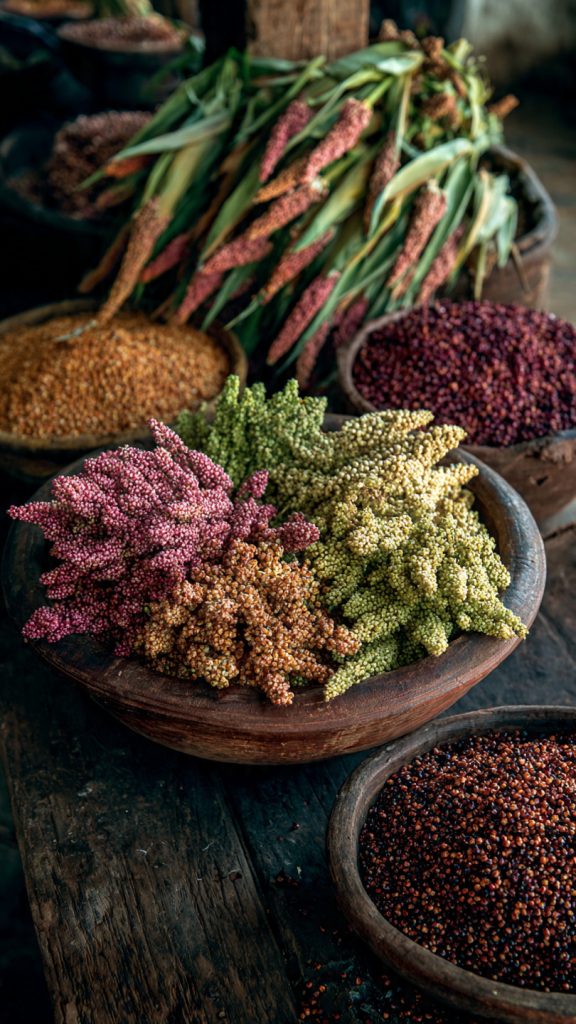
How Cross-Border Trade Is Reviving Sorghum
Migration routes are becoming organic grain corridors—here’s why it matters
A Quiet Revival Along Southern Africa’s Borders
In 2023, South Africa imported over 280,000 tonnes of sorghum, much of it moving informally across borders before entering formal markets.
This shift signals more than a trade adjustment. It reflects a nutritional, economic, and cultural revival driven by migrant communities.
Sorghum once anchored Southern African diets. Today, Mozambican, Zimbabwean, and Malawian migrants are bringing it back—one sack, one market stall, one urban household at a time.
As migration reshapes food systems, sorghum is emerging as a cross-border public health asset.
This article argues that migration routes now function as organic grain corridors. These corridors strengthen nutrition security, support livelihoods, and challenge policy blind spots in South Africa’s food and health systems.
Why Sorghum Matters for Public Health
A Climate-Smart Nutritional Powerhouse
Sorghum offers clear health advantages:
-
High dietary fibre improves gut health
-
Low glycaemic index supports diabetes management
-
Rich iron and zinc content reduces micronutrient deficiencies
-
Gluten-free properties benefit people with sensitivities
Importantly, sorghum thrives in heat and drought, conditions intensifying across Southern Africa.
In contrast, maize yields declined sharply during recent El Niño-linked droughts (2022–2024).
Public health implication: Sorghum supports both nutrition resilience and climate adaptation.
Migration and Food Systems: An Overlooked Connection
Migration rarely features in South Africa’s food policy debates.
Yet migrants play a central role in seed circulation, informal trade, and food knowledge transfer.
How Grain Moves With People
Migrants transport sorghum in multiple ways:
-
Small-scale cross-border trade via Beitbridge and Lebombo
-
Informal wholesalers supplying townships in Gauteng and KwaZulu-Natal
-
Cooperative buying networks in inner-city Johannesburg and Durban
These routes mirror historical trade paths disrupted by colonial agriculture policies that favoured maize and wheat.
In effect, migration restores older food economies.
Evidence From South Africa’s Major Cities
Johannesburg: From Informal Markets to Health-Food Shelves
In Hillbrow and Yeoville, Zimbabwean traders sell sorghum meal alongside traditional vegetables.
Meanwhile, health-food retailers in Rosebank now market sorghum as a “super grain.”
This dual demand highlights inequality:
-
Migrants consume sorghum for affordability and cultural continuity
-
Middle-class consumers adopt it for wellness trends
Policy gap: No integration exists between informal traders and formal food-safety or nutrition programs.
Durban: Sorghum as Urban Food Security
In KwaMashu and Umlazi, Mozambican women sell fermented sorghum beverages and porridges.
These foods support household incomes and child nutrition.
However, municipal bylaws often criminalise informal food trade.
As a result, women face fines, confiscation, and harassment.
Gendered vulnerability remains invisible in urban food policy.
Polokwane: Cross-Border Farming Knowledge Transfer
In Limpopo, Malawian migrants lease small plots and grow sorghum using low-input methods.
Local farmers increasingly adopt these practices as rainfall declines.
Yet extension services rarely engage migrant farmers.
Documentation status blocks access to training and subsidies.
Case Examples From the Ground (Anonymised)
Case 1: “Tariro,” Zimbabwean Trader, Johannesburg
Tariro imports sorghum monthly via informal networks.
She supplies three township shops and supports six dependents.
Despite this, she lacks permits and fears border closures.
Her business operates entirely outside state support.
Case 2: “Amina,” Mozambican Vendor, Durban
Amina sells sorghum porridge near a taxi rank.
Mothers buy it because it keeps children full longer than refined maize meal.
When metro police confiscated her stock, her family lost a week’s income.
Case 3: “Joseph,” Malawian Small-Scale Farmer, Limpopo
Joseph introduced drought-resistant sorghum varieties to neighbouring South African farmers.
He receives no recognition, training, or land security.
Yet his methods now spread informally across the district.
Policy Analysis: Where South Africa Falls Short
Food and Nutrition Security Policy (2017)
The policy promotes dietary diversity.
However, it prioritises commercial maize and wheat value chains.
Missed opportunity: Indigenous grains receive minimal funding.
National Health Act & NHI Framework
Nutrition prevention receives rhetorical support.
Yet migrant-led food systems remain excluded from implementation plans.
Border and Trade Policy
Sorghum moves mostly through informal channels.
Current customs systems treat this trade as illicit rather than developmental.
Result: Lost tax revenue, unsafe transport, and trader vulnerability.
Intersectional Dimensions Often Ignored
-
Gender: Women dominate informal sorghum trade but face policing and income insecurity
-
Nationality: Zimbabwean and Mozambican migrants experience higher enforcement scrutiny
-
Documentation status: Undocumented traders avoid health inspections, increasing food-safety risks
-
Age: Older migrants retain indigenous grain knowledge, yet no policy captures this expertise
Ignoring these factors weakens both health and economic outcomes.
Emerging Innovations Worth Scaling
1. Cross-Border Grain Cooperatives (Zimbabwe–SA)
NGOs facilitate semi-formal trader registration.
This improves food safety and income stability.
2. Indigenous Grain School Feeding Pilots
In Limpopo and KwaZulu-Natal, NGOs introduce sorghum into ECD centres.
Early results show improved satiety and attendance.
3. Climate-Smart Urban Agriculture Programs
Some metros now support rooftop sorghum trials.
Migrants often lead these projects.
Actionable Recommendations
Short Term (0–12 Months)
-
Legalise and register small-scale cross-border grain traders
-
Include sorghum in municipal food-relief programs
-
Train environmental health officers on culturally appropriate enforcement
Medium Term (1–3 Years)
-
Integrate indigenous grains into school nutrition and NHI prevention strategies
-
Fund migrant-inclusive agricultural extension services
-
Support women-led sorghum cooperatives in urban areas
Long Term (3–5 Years)
-
Reform trade policy to recognise informal food corridors
-
Invest in regional indigenous grain research hubs
-
Embed migration-aware food systems into national health planning
Research Gaps That Demand Attention
-
Limited epidemiological data on indigenous grain consumption among migrants
-
Under-documentation of informal food economies
-
Weak evaluation of nutrition outcomes in migrant-led food initiatives
Addressing these gaps strengthens evidence-based policy.
Conclusion: A Grain That Crosses Borders—and Disciplines
Sorghum’s return is not accidental.
Migrants carry seeds, skills, and survival strategies across borders.
If South Africa recognises these organic grain corridors, it can:
-
Improve nutrition outcomes
-
Build climate-resilient food systems
-
Advance inclusive health policy
The choice is clear: criminalise the corridor—or cultivate it.
Selected References (2020–2025)
-
FAO. The State of Food Security and Nutrition in the World.
-
Stats SA. General Household Survey.
-
Department of Health. National Nutrition Strategy.
-
Department of Agriculture. Indigenous Crops Development Framework.
Recent Posts:
- Durban’s Kitchen Gardens: What Mozambican and Zimbabwean Migrants Know About Growing Food in Concrete
- When Miners Become Farmers: The Zambian Copperbelt Workers Returning Home to Reclaim the Land
- The WhatsApp Groups Feeding Harare: How the Diaspora Is Bankrolling Zimbabwe’s Urban Organic Food Movement
- From Tsumeb to Thohoyandou: The Namibian Farmers Bringing Drought-Resistant Indigenous Crops Across Borders
- Why Botswana’s Returning Migrants Are Ditching Chemicals and Going Back to the Old Ways