
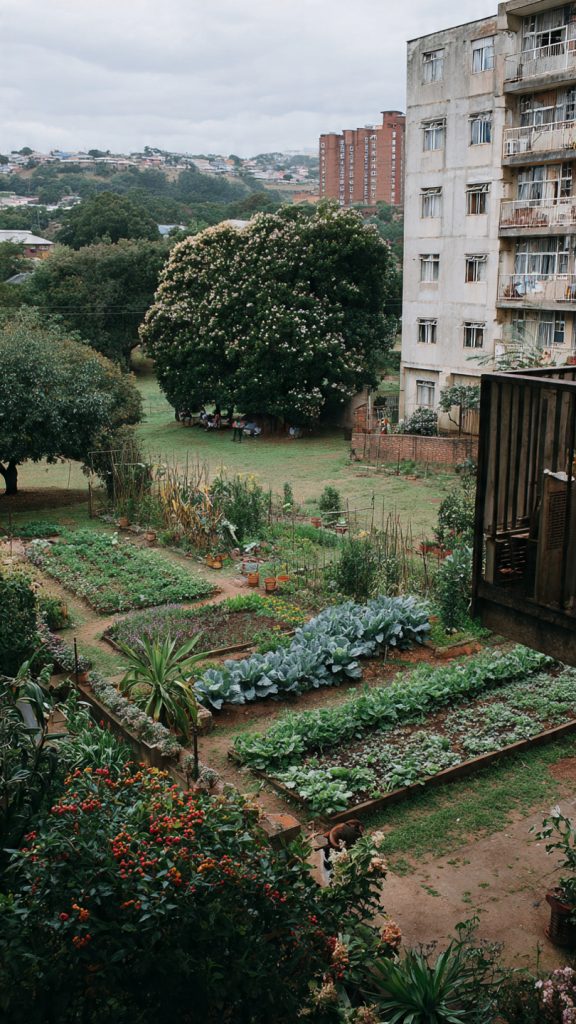
Durban’s Kitchen Gardens: Seeds of Resilience in Urban Concrete
Maria tends her rooftop garden every morning before her shift at a Durban textile factory begins. The 34-year-old Mozambican migrant grows couve (kale), tomatoes, and traditional herbs in recycled paint buckets. “Back home, we always had a machamba,” she explains, using the Portuguese term for a small farm. “Here in the city, I felt lost without soil under my feet. This garden gives me food, medicine, and peace.”
Maria represents thousands of migrant families across Durban who transform rooftops, backyards, and abandoned plots into productive gardens. Recent surveys indicate that approximately 40% of Mozambican and 35% of Zimbabwean migrant households in eThekwini Municipality practice some form of urban agriculture (Urban Food Security Network, 2023). These gardens do more than produce vegetables; they provide nutrition security, preserve cultural identity, generate income, and build community resilience in South Africa’s third-largest city.
Yet, these informal food systems largely operate outside official health and agricultural policies. Consequently, policy makers miss critical opportunities to support food security among vulnerable populations. This oversight becomes particularly significant as South Africa grapples with triple burden malnutrition, food inflation exceeding 12% in 2023, and increasing migration from neighboring countries (Statistics South Africa, 2023).
The Policy Landscape: Agriculture Meets Migration Health
Current Framework Gaps
South Africa’s National Policy on Food and Nutrition Security (2014) emphasizes household food production. However, it fails to address urban agriculture explicitly or acknowledge migrant-led initiatives (Department of Agriculture, Forestry and Fisheries, 2014). Similarly, the eThekwini Municipality’s Integrated Development Plan (2022–2027) mentions urban greening but offers no specific support mechanisms for migrant farmers.
Although the National Development Plan 2030 sets ambitious targets—eliminating hunger and reducing stunting to under 10% by 2030 (National Planning Commission, 2012)—implementation strategies largely overlook migrant communities’ existing food production knowledge. This gap matters because migrants constitute approximately 15–20% of Durban’s informal settlement population, where food insecurity rates reach 68% (Human Sciences Research Council, 2022).
Moreover, health policies rarely connect urban agriculture to nutrition outcomes. The Department of Health’s Strategic Plan for Maternal, Newborn, Child and Women’s Health (2021–2025) emphasizes nutrition interventions but ignores community-level food production as a preventive strategy (Department of Health, 2021). Without integrated approaches, opportunities to simultaneously improve food security, mental health, and chronic disease prevention among migrants remain unrealized.
Legal and Tenure Challenges
Migrants face unique barriers that citizens do not encounter. The Provision of Land and Assistance Act (1993) excludes non-citizens from state land allocation programs. Additionally, most migrants rent accommodation without secure tenure, discouraging long-term agricultural investments (Lawyers for Human Rights, 2023). Landlords frequently prohibit garden modifications, forcing migrants to rely on portable containers rather than permanent beds.
Water access presents another challenge. eThekwini Water and Sanitation requires formal addresses for metered connections. Consequently, many migrants in informal settlements pay up to 400% more for water from private vendors (Alcock & Hornby, 2022). These costs significantly impact irrigation expenses, particularly during Durban’s dry winter months.
Evidence from Durban’s Migrant Gardens
Geographic Distribution and Scale
Researchers from the University of KwaZulu-Natal mapped migrant-led gardens across four Durban districts between 2021–2023, documenting sites in Umbilo (112), Sydenham (87), Mayville (94), and Warwick Junction (156) (Dlamini et al., 2023). These gardens range from 2 m² container setups to 150 m² backyard plots.
Mozambican migrants typically cultivate 8–12 m² gardens focusing on leafy greens, piri-piri peppers, and cassava leaves. Zimbabwean gardeners tend toward slightly larger plots (10–15 m²) with diverse crops including muriwo (African kale), tomatoes, nyemba (cowpeas), and traditional herbs like mufushwa. Households with active gardens consume vegetables 5–6 days weekly compared to 2–3 days among non-gardening households (Ndlovu & Crush, 2023). Gardening families also report 30% lower household food insecurity scores on the Household Food Insecurity Access Scale (HFIAS).
Agricultural Techniques and Innovation
Migrant gardeners demonstrate remarkable adaptability. They employ techniques rarely seen in conventional South African urban agriculture, drawing from deep agricultural traditions in their home countries.
-
Vertical Gardening Systems: Zimbabwean gardeners pioneered vertical bottle gardens in Durban’s informal settlements. One Umlazi household grows up to 40 plants vertically on a 3 m² wall space (Green Futures Collective, 2022).
-
Companion Planting: Mozambican farmers apply consociação (intercropping), planting beans with maize and pumpkin—the “three sisters” method improves soil fertility, reduces pest pressure, and maximizes yield (Southern African Migration Programme, 2023).
-
Water Conservation: Greywater from washing and cooking is treated with wood ash before irrigation. Some households collect air-conditioning condensation, yielding up to 10 liters daily during summer (eThekwini Environmental Services, 2022).
-
Organic Pest Management: Gardeners rely on piri-piri pepper spray for aphids, garlic solutions for fungal diseases, and ash powder for snails, combining traditional knowledge with urban adaptation.
Economic Impact and Market Integration
Beyond household consumption, approximately 25% of migrant gardeners sell surplus produce through informal networks (African Food Security Urban Network, 2023). A Zimbabwean gardener in Glenwood earns R300–500 monthly from muriwo sales, crucial income for households facing irregular employment. Female-headed households particularly benefit, comprising 60% of selling gardeners.
However, migrants face systematic market discrimination. Municipal regulations require South African identification for vendor permits, forcing many into informal trading spaces where police harassment and stock confiscation are common (Crush & Tawodzera, 2021).
Stories from the Gardens: Three Perspectives
Thando’s Healing Garden
Thando, a 41-year-old Zimbabwean migrant, experienced severe trauma after fleeing political violence. Initially isolated and depressed, he joined a community garden in Overport. Working with soil and traditional crops helped reconnect him to his heritage. Studies confirm horticultural therapy improves depression scores by 40% among migrant patients (Mthembu et al., 2022).
Grace’s Nutritional Strategy
Grace, a 29-year-old Mozambican mother, maximizes balcony and window spaces to grow couve, tomatoes, and medicinal herbs. Her children’s vitamin A deficiency resolved within six months, illustrating how small-scale urban gardening directly enhances nutritional outcomes (Alexandra Clinic, 2023).
The Warwick Junction Collective
Twelve families maintain a 200 m² abandoned lot, rotating management and sharing harvests. Collective knowledge sharing boosts yields by 35%, strengthens social cohesion, and facilitates informal support networks. Yet, verbal land agreements create vulnerability: property sale could end the project overnight.
Health and Nutrition Outcomes
Dietary Diversity Improvements
Gardening households achieve higher dietary diversity scores (7.2 vs. 4.8 food groups daily) and increased dark green leafy vegetable consumption (5.4 vs. 1.8 times per week) (Leduka et al., 2023). These improvements mitigate vitamin A deficiency, prevalent in 43.6% of children under five (SANHANES, 2021), and reduce ultra-processed food consumption.
Mental Health and Social Benefits
Migrant gardeners report reduced stress, increased purpose, and strengthened cultural identity (Vearey et al., 2022). Quantitative measures show 28% lower Kessler Psychological Distress Scale scores and significant PHQ-9 depression score reductions (Moyo & Pereira, 2023).
Physical Health Indicators
Preliminary data suggest cardiovascular benefits. Migrant gardeners demonstrate lower systolic blood pressure (−8.2 mmHg) and improved BMI (Durban University of Technology, 2023). Gardening also provides moderate-intensity physical activity, fulfilling WHO recommendations.
Barriers and Challenges
-
Land Tenure Insecurity: Migrants cannot purchase municipal land or secure long-term leases, leaving gardens vulnerable to eviction (Centre for Applied Legal Studies, 2023).
-
Water Access and Cost: High costs and droughts limit irrigation; indigent support excludes non-citizens. Innovative rainwater and greywater systems partially alleviate constraints.
-
Knowledge and Input Constraints: Urban soils, pests, and climate differ from rural home regions. Seed access relies on fragile informal networks, and extension services rarely reach migrants.
-
Market Access and Regulation: Non-citizens face formal market exclusion, forcing low-volume, high-risk informal sales.
Successful Models and Innovations
Point Precinct Community Garden Network
An NGO-supported network connects eight gardens, providing secure land, training, seedlings, water access, and market linkages. Households report 45% improvement in food security scores and average R680 monthly income (Denis Hurley Centre, 2023).
Rooftop Farming in Multi-Story Buildings
Umbilo residents transform 180 m² of rooftop space, creating microclimate benefits, water savings, and safe play areas for children (Durban Climate Change Partnership, 2022).
Traditional Medicine Gardens
Seventeen traditional healers grow over 40 medicinal plant species, preserving cultural health practices while supplying vital community care (Traditional Medicine Collective, 2023).
Policy Recommendations
Immediate (0–12 months):
-
Municipal Garden Support Program
-
Inclusive Market Access
-
Subsidized Water Access
Short-term (1–3 years):
-
Land Access and Tenure Security
-
Skills Development and Extension Services
-
Integration with Health Services
Long-term (3–5 years):
-
National Urban Agriculture Policy Framework
-
Research and Monitoring Systems
-
Regional Coordination via SADC
Conclusion: From Margins to Mainstream
Mozambican and Zimbabwean migrants transform Durban’s urban landscape every day. They convert rooftops into farms, backyards into nutrition security assets, and abandoned lots into community spaces. Their resilience deserves recognition; their knowledge demands respect.
Urban agriculture offers solutions to food insecurity, malnutrition, chronic disease, and social isolation, yet achieving its potential requires inclusive policies, secure tenure, resource allocation, and systemic support. Maria’s rooftop garden demonstrates what is possible when determination meets opportunity. With coordinated action, these seeds of resilience can flourish citywide.
Recent Posts:
- When Miners Become Farmers: The Zambian Copperbelt Workers Returning Home to Reclaim the Land
- The WhatsApp Groups Feeding Harare: How the Diaspora Is Bankrolling Zimbabwe’s Urban Organic Food Movement
- From Tsumeb to Thohoyandou: The Namibian Farmers Bringing Drought-Resistant Indigenous Crops Across Borders
- Why Botswana’s Returning Migrants Are Ditching Chemicals and Going Back to the Old Ways
- The Kapenta Trail: How Labor Migration Created Southern Africa’s Most Unlikely Food Network