
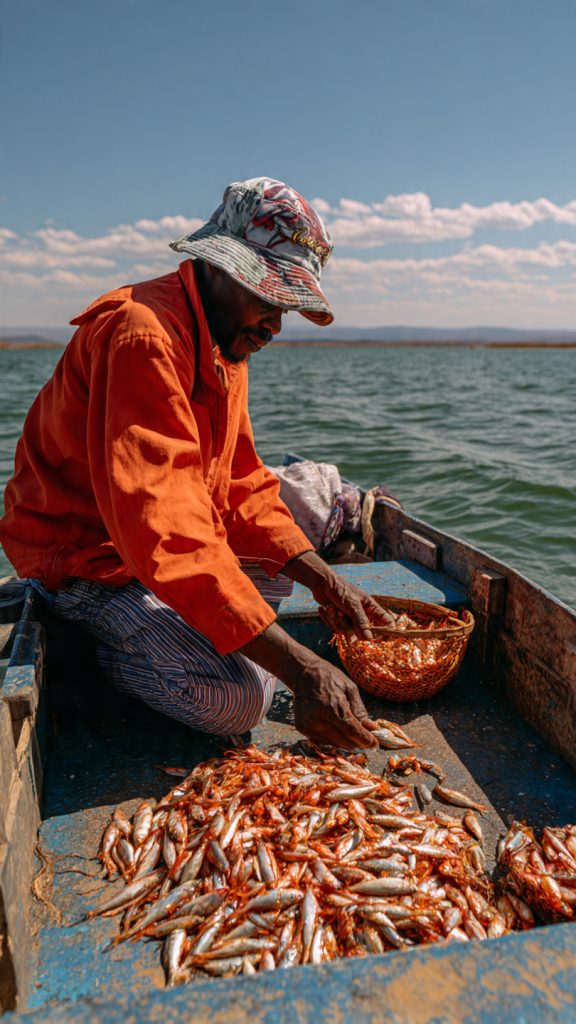
Migration on the Menu: Kapenta, Food, and Health
Following fish, families, and farming knowledge from Lake Kariba to the Cape
Opening: A Fish That Travels Further Than People
In 2023, dried kapenta from Lake Kariba appeared in informal markets across Johannesburg, Cape Town, and Gqeberha. Alongside mielie meal and tomatoes, traders sold it to low-income households. Most buyers were migrants. Many were women. Yet few policy makers noticed.
Nevertheless, this small fish tells a much larger story. It traces labor migration, food security, and public health across Southern Africa. Moreover, kapenta feeds households that formal systems routinely overlook. It provides protein, calcium, and essential fatty acids at a low cost.
At the same time, kapenta moves through informal supply chains shaped by migration. These networks link Zimbabwe, Zambia, and South Africa. Consequently, they shape urban diets while sustaining rural fishing communities. This article follows that trail. It connects migration to nutrition, health systems, and policy. Finally, it ends with clear actions for government, NGOs, and researchers.
Why Kapenta Matters for Health Policy
Kapenta looks small. Its impact is not.
First, kapenta fills protein gaps in urban diets. Because poor households rely on affordable animal protein, it often costs less than chicken or beef. In addition, it stores well, since dried fish travels without refrigeration. Finally, it fits migrant economies, as migrants use social networks to move food across borders when formal markets fail them.
However, these benefits come with risks. Informal processing raises food safety concerns. Cross-border trade exposes workers to exploitation. Weak policy coordination leaves gaps in health access for traders and consumers.
Therefore, kapenta offers a policy lens. It reveals how migration, food systems, and health intersect.
The Migration–Food Nexus in Southern Africa
Labor migration has long shaped the region. Men moved to mines. Women followed trade routes. Today, migration looks different. Circular migration dominates. So does informal work.
Zimbabwean and Zambian fishers supply kapenta from Lake Kariba. Traders, many of them women, dry and transport the fish. Migrant relatives in South Africa distribute it through spaza shops and street markets.
These networks rely on trust. They bypass formal regulation. They also bypass formal health protections.
Consequently, migrants shoulder health risks. Long travel increases exposure to TB and HIV. Poor housing in destination cities worsens respiratory disease. Stress and food insecurity compound mental health burdens.
Evidence from South African Cities
Johannesburg and Tshwane
In inner-city Johannesburg, kapenta markets cluster near migrant housing. Hillbrow and Yeoville stand out. Here, migrants report using kapenta to stretch household budgets. Community health workers note its role in child nutrition. Yet inspectors rarely monitor these markets.
Cape Town
In Cape Town’s townships, kapenta appears in informal stalls near transport hubs. Traders report harassment and confiscation of goods. Health outreach teams struggle to reach mobile traders. Language barriers persist.
eThekwini and Gqeberha
In Durban and Gqeberha, kapenta links coastal fish economies to inland migrant networks. NGOs report that women traders face high rates of violence and limited access to clinics due to documentation barriers.
Across cities, the pattern repeats. Food flows faster than policy.
Policy Landscape: What Exists and What’s Missing
South Africa has strong health policy on paper. In principle, the National Health Act guarantees emergency care, while primary health care should remain broadly accessible. At the same time, national nutrition policies explicitly address food security. However, gaps persist between policy design and lived reality.
To begin with, migration and health policy rarely align. As a result, departments continue to operate in silos. Meanwhile, informal food systems fall outside routine monitoring, even though they feed millions. At the local level, municipalities also lack guidance on how to engage migrant traders in ways that protect both health and livelihoods.
Moreover, the National Health Insurance reform promises inclusion. In practice, implementation remains uneven. Migrants still report denial of care, and fear of arrest continues to deter clinic visits. Consequently, policy intent does not translate into practice.
Voices from the Kapenta Trail (Anonymized)
Case 1: “Rudo,” trader, Johannesburg
Rudo crosses borders monthly. She supports family in Kariba. She sells kapenta in Yeoville. Police raids disrupt her work. She avoids clinics after a nurse asked for documents.
Case 2: “Thabo,” community health worker, Cape Town
Thabo sees malnutrition among migrant children. Kapenta helps. Yet he lacks food safety guidance. He also lacks interpreters.
Case 3: “Ms. N,” municipal official, Tshwane
Ms. N wants to support informal traders. She lacks a mandate. Health, trade, and migration policies do not speak to each other.
These stories reflect systemic failures, not individual choices.
Intersectional Risks and Inequalities
Intersectional risks shape every stage of the kapenta trail. In particular, gender matters. Because women dominate small-scale trade, they face higher exposure to violence, extortion, and unpaid care burdens.
Similarly, nationality matters. Zimbabwean and Zambian migrants experience xenophobia in markets, at borders, and in clinics. In turn, documentation status strongly shapes whether health facilities provide care or turn people away.
Age also plays a role. On one hand, children benefit nutritionally from kapenta consumption. On the other hand, older traders often live with chronic illness without continuity of care. Taken together, these overlapping risks show why one-size-fits-all policies fail. Therefore, intersectional design is not optional; it is essential.
Public Health Risks Along the Chain
Food safety remains a concern. Drying practices vary. Storage conditions fluctuate. Contamination risks rise in humid climates.
Occupational health risks persist. Fishers face injury and exposure. Traders face long hours and stress. Transporters face violence at borders.
At the same time, kapenta improves diets. It reduces reliance on ultra-processed foods. Ignoring it would harm nutrition outcomes.
Hence, policy must manage risk without destroying livelihoods.
What Works: Innovative and Community-Led Responses
Several initiatives offer lessons.
First, NGO-led trader health days in Johannesburg bring mobile clinics to markets. Uptake improves when services avoid documentation checks.
Second, cross-border trader associations share food handling knowledge. Peer training raises safety standards.
Third, municipal pilot permits in parts of Gauteng reduce harassment. Traders register without immigration enforcement.
These programs succeed because they build trust.
Actionable Recommendations and Timelines
Short Term (0–12 months)
- Issue municipal guidelines for engaging migrant food traders.
- Expand mobile clinics to informal markets.
- Train environmental health officers on migrant-sensitive approaches.
Medium Term (1–3 years)
- Integrate migration into national nutrition strategies.
- Fund cross-border food safety training with SADC partners.
- Standardize clinic protocols to prevent unlawful denial of care.
Long Term (3–5 years)
- Align health, trade, and migration policy under NHI implementation.
- Support regional data systems on migrant nutrition and health.
- Formalize safe corridors for informal food trade.
Each step requires coordination. Each step remains feasible.
Implications for Stakeholders
Policy makers: Treat informal food systems as health assets, not threats.
Health practitioners: Deliver care without fear or prejudice.
NGOs: Scale community-led models. Document impact.
Researchers: Study nutrition outcomes along migrant supply chains.
Collaboration matters. Delay costs lives.
Limitations and Research Gaps
Data on informal food trade remains scarce. City-level nutrition surveillance rarely disaggregates by migration status. Food safety studies often exclude dried fish.
Future research should track health outcomes across borders. It should also evaluate policy pilots rigorously.
Conclusion: Following the Fish to Fix the System
Kapenta travels far because people must. It feeds cities because policies fail to keep up. Following this fish reveals hidden systems. It also reveals solutions.
If South Africa wants equitable health reform, it must start where people live and eat. The kapenta trail shows the way.
Selected References (2020–2025)
- South African National Department of Health. National Health Act and PHC guidelines.
- National Treasury. National Health Insurance policy documents.
- Statistics South Africa. Migration and food security datasets.
- FAO. Migration, food systems, and nutrition in Southern Africa.
- IOM. Regional migration health reports.
- HSRC. Urban food security studies.
- SAMRC. Nutrition and non-communicable disease reports.
- SADC. Cross-border trade and food safety frameworks.
- Médecins Sans Frontières. Migrant health access reports.
- Scalabrini Institute. Migration and urban poverty research.
- University of the Witwatersrand. Inner-city health studies.
- University of Cape Town. Informal economy research.
- Human Sciences Research Council. Xenophobia and health access.
- UNICEF South Africa. Child nutrition reports.
- WHO AFRO. Migration and health policy guidance.