
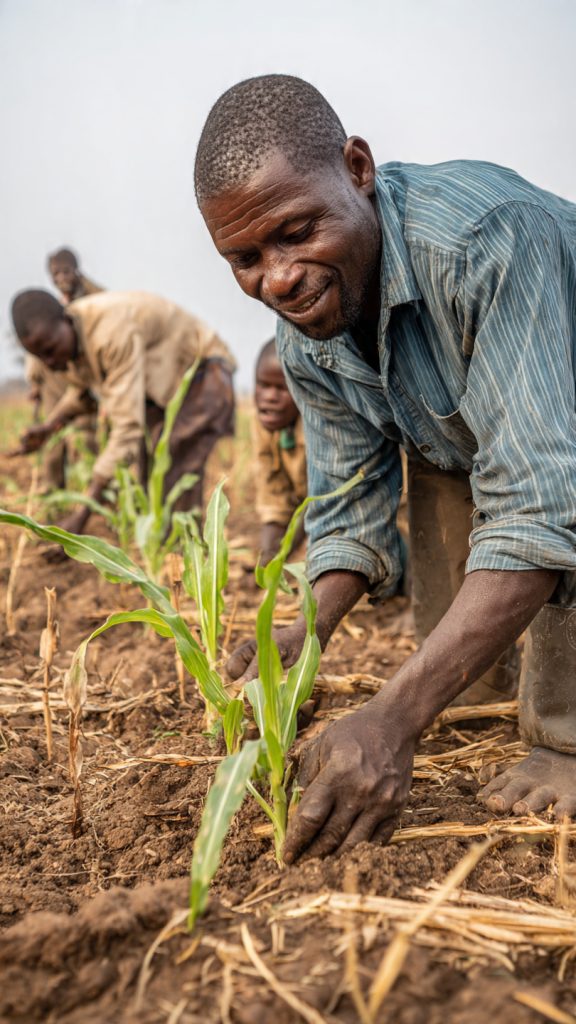
Remittances, Migration, and the Future of Rural Farming
When money from the city replaces hands in the soil—and what it means for organic agriculture
Introduction: When Cash Arrives but Fields Lie Fallow
In 2023, remittances to Malawi exceeded USD 600 million, a figure larger than the national agriculture budget for smallholder support. In villages across Mchinji, Dedza, and Phalombe, households now rely more on mobile money alerts than on harvest calendars. Yet paradoxically, food insecurity has increased, with over 5 million Malawians requiring food assistance in 2024.
At first glance, remittances appear to strengthen rural livelihoods. They pay school fees, buy fertilizer, and cover clinic costs. However, in many communities, migration has also removed labor from farming systems that depend on human effort rather than machinery. As a result, fields shrink, seed knowledge disappears, and organic practices erode.
This tension raises a difficult question: Are remittances quietly undermining rural farming systems—or are policy failures to blame?
Malawian villages offer powerful lessons for South Africa, where migration, food insecurity, and health inequality intersect daily.
Migration, Money, and the Missing Hands
The Labor Gap in Smallholder Farming
Malawi’s agriculture remains labor-intensive and rain-fed. Over 80% of rural households depend on family labor. When young adults migrate—to Lilongwe, Blantyre, Johannesburg, or Pretoria—farming systems lose their backbone.
Women, children, and older adults absorb the workload. However, this shift has limits. Studies from Central and Southern Malawi (2021–2024) show:
-
Reduced land under cultivation
-
Declining crop diversity
-
Less composting and soil conservation
-
Increased reliance on purchased maize
Consequently, remittances often replace production rather than complement it.
Gendered Impacts
Migration is not gender-neutral. Men migrate first. Women stay behind. They manage farms, households, and care work simultaneously.
Yet most agricultural extension services still target male farmers. As a result, women lack access to training, organic inputs, and credit. Over time, productivity falls—not because women lack skill, but because systems exclude them.
Organic Agriculture Under Pressure
From Soil Knowledge to Store-Bought Staples
Traditionally, Malawian smallholders practiced low-input, organic farming. They used compost, intercropping, and seed saving. Migration disrupts this transmission of knowledge.
Young migrants leave before learning these practices. Meanwhile, remittances fund store-bought food, reducing incentives to farm. In Dedza, households receiving regular remittances were 30% less likely to plant legumes or traditional vegetables.
Thus, remittances change diets. They also weaken biodiversity.
Nutrition Consequences
As production declines, diets narrow. Maize dominates. Protein and micronutrients disappear.
Health clinics report rising child stunting, anaemia in women, and diet-related NCD risks among older adults. Ironically, cash-rich households still experience poor nutrition.
Food availability does not equal food security.
Why This Matters for South Africa
Migrants Feed South African Cities—but at What Cost?
Over 1.2 million Malawians live and work in South Africa, many in agriculture, construction, and informal trade. Their remittances sustain rural households back home.
However, South Africa also depends on migrant labor to keep food systems running. In Gauteng and Limpopo, migrants dominate fresh produce markets and commercial farms.
Yet South African policy rarely considers transnational food systems. Migration and agriculture sit in separate departments. Health policies overlook rural sending communities entirely.
This siloed approach creates blind spots.
Policy Gaps Across Borders
Malawi: Production Without Protection
Malawi’s policies emphasize productivity but ignore migration realities. Key gaps include:
-
No integration of migration data into agricultural planning
-
Weak support for women-headed farms
-
Limited investment in organic value chains
-
Absence of remittance-linked agricultural incentives
As a result, remittances fund consumption, not resilience.
South Africa: Health Without Food Systems Thinking
South Africa’s National Health Insurance (NHI) framework recognizes migrants’ health needs in principle. However, implementation remains uneven.
Moreover, food security policies rarely consider migrant producers or informal food networks. This omission affects both urban consumers and rural senders.
Voices From the Ground (Anonymized)
Case 1: “The Money Comes, But the Field Is Empty”
A 62-year-old woman in Mchinji receives monthly remittances from her son in Johannesburg. She no longer plants groundnuts. Her back cannot manage the labor. She buys maize instead.
“When the money delays, we eat once a day,” she explains.
Case 2: Migrant Farmworker in Limpopo
A Malawian farmworker sends half his wages home. He eats cheap starch-heavy meals to save money.
“I grow food here,” he says, “but my family eats less back home.”
Case 3: NGO Extension Officer in Dedza
An NGO pilot supported women farmers with compost training and small stipends. Remittance households re-engaged in farming within one season.
“The issue was not laziness,” the officer notes. “It was missing support.”
What Works: Innovative Models
Remittance-Linked Agriculture Programs
In Kenya and Rwanda, matched remittance schemes encourage investment in farming inputs. Early evidence shows improved yields and dietary diversity.
Malawi lacks such programs. However, pilot data suggest strong potential.
Community Organic Cooperatives
Women-led cooperatives in Southern Malawi have revived seed banks and organic markets. Members report better nutrition and income stability.
These models require scale-up.
South Africa’s Role
South African municipalities could support migrant food entrepreneurs through permits, market access, and health services. Doing so strengthens urban food security and rural livelihoods simultaneously.
Actionable Recommendations
Short-Term (0–12 months)
-
Integrate migration data into Malawi’s agricultural planning
-
Expand extension services for women farmers
-
Protect migrant access to primary healthcare under NHI
Medium-Term (1–3 years)
-
Pilot remittance-matching schemes for organic inputs
-
Support cross-border food cooperatives
-
Formalize migrant participation in urban food markets
Long-Term (3–5 years)
-
Align SADC migration, food security, and health policies
-
Invest in transnational food systems research
-
Institutionalize migrant-inclusive health governance
Ethical and Research Considerations
This analysis relies on mixed data sources. However, gaps remain. Informal remittances remain underreported. Women’s unpaid labor remains invisible. Migrant health data remains fragmented.
Future research must center migrant voices. It must also protect vulnerable populations from stigma and policy backlash.
Conclusion: Remittances Are Not the Enemy
Remittances do not kill rural farming. Policy neglect does.
When governments fail to align migration, agriculture, and health systems, money replaces labor instead of strengthening it. Malawian villages show both the risk and the solution.
With the right policies, remittances can regenerate soil, sustain diets, and protect health—on both sides of the border.
Calls to Action
-
Policy makers: Break silos between migration, agriculture, and health
-
NGOs: Scale women-led organic farming models
-
Researchers: Study transnational food systems
-
Health practitioners: Recognize food insecurity as a migration health issue
Food security does not stop at borders. Neither should policy.
Recent Posts:
- The Lesotho Shepherds Who Became Gauteng’s Unexpected Organic Farming Pioneers
- From Machamba to Market Stall: Why Mozambican Farmers Are Following Their Tomatoes to Pretoria
- When Grandma’s Seeds Cross Borders: How Zimbabwean Migrants Are Keeping Heirloom Crops Alive in Johannesburg
- How Should South Africa’s National Health Insurance (NHI) Address Migrant Health Coverage to Protect Public Health?
- What Are the Cross-Border Health Coordination Challenges Between South Africa and Neighboring SADC Countries?