
Kenya’s Approach to Climate Migration: Implications for South Africa
Opening: A Case in Point
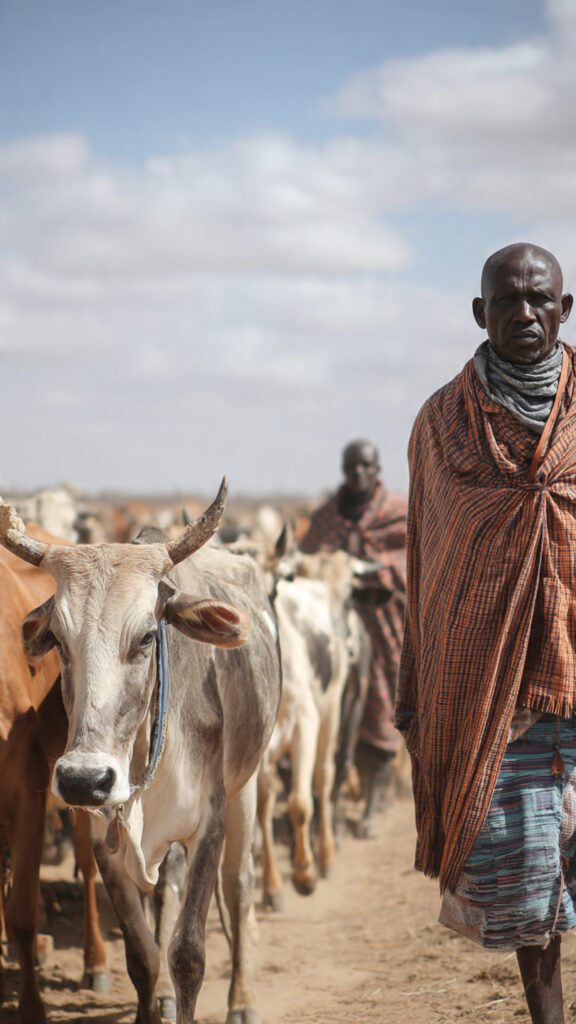
In north-eastern Kenya’s arid lands, decades of drought have forced many pastoralist communities to relocate or adapt their livelihoods. A recent study of the Maasai in Laikipia County found drought is the main driver of migration aspirations (icld.se).
Meanwhile, in South Africa, millions live in informal settlements vulnerable to extreme weather. Floods, heat waves, and drought increase public health risks. Amnesty International reported that over five million people in informal settlements face climate-driven hazards (amnesty.org).
Displacement disrupts access to healthcare and increases exposure to disease. Both rural–urban and cross-border movements strain health systems. South Africa can learn from Kenya’s management of climate-displaced pastoralists. Lessons include integrating mobility into public health and climate adaptation policies.
Kenya’s Approach: Key Features and Lessons
1. Recognising Pastoral Mobility as Adaptation
In Kenya’s ASALs, mobility is central to surviving variable rainfall and pasture scarcity. A 2023 study in West Pokot County found that 63.5% of pastoralist households migrate during droughts (erepository.uonbi.ac.ke).
Mobility is treated as an adaptive strategy, not a failure. Governance, land tenure, and rangeland access shape the success of mobility. Laikipia researchers noted that vulnerability increases migration aspirations but reduces capabilities (lup.lub.lu.se).
Lesson for South Africa: Recognise migration as adaptation. Policies should integrate migrants into health and social systems, rather than treat them as outsiders.
2. Linking Climate Resilience, Mobility, and Governance
Kenyan studies show that mobility, climate, and governance are inseparable. In Kajiado County, land privatization reduced seasonal movement, causing livestock losses of ~30% annually (erepository.uonbi.ac.ke).
During the 2020‑2023 drought, weak governance and disrupted mobility worsened vulnerability (unfccc.int).
Lesson for South Africa: Migration-health strategies must include governance, mobility corridors, and social protection for displaced persons.
3. Livelihood Diversification and Early Adaptation
Kenyan pastoralists diversify to reduce vulnerability. They adopt agro-pastoralism, drought-resilient livestock, water harvesting, and community-based strategies (journals.chuka.ac.ke).
Female-headed households are especially vulnerable. Programs targeting women and youth improve resilience (journals.unesco.go.ke).
Lesson for South Africa: Implement livelihood resilience programs for climate-displaced populations. Integrate gender, age, and documentation-sensitive approaches.
4. Integrating Mobility and Health
Kenya links mobility, health, and displacement frameworks (environmentalmigration.iom.int).
Lesson for South Africa: Treat climate-driven migration as a health system issue. Integrate health, mobility, and climate resilience into policy and planning.
South Africa’s Situation: Gaps and Intersections
Policy and Practice Gaps
-
Informal settlement residents lack reliable services (iol.co.za).
-
Climate migrants are not recognised under current migration policies (defenceweb.co.za).
-
Urbanisation is growing: 71.3% of South Africans may live in urban areas by 2030 (gov.za).
-
Health systems lack a migration-health lens.
-
Intersectional vulnerabilities are under-addressed, especially for women, older persons, and undocumented migrants.
Anonymised Case Examples
Fatima, 29, undocumented, moved from Zimbabwe to Johannesburg in 2022 due to drought. She lives in a flood-prone informal settlement. Clinic access is limited. Heavy rains in 2025 forced her to relocate temporarily.
Samuel, 62, an internal migrant from Limpopo, sold his livestock after displacement. He lives in a backyard shack near Pretoria. Chronic hypertension and mobility issues worsened during floods.
These cases illustrate the intersection of climate stress, health, migration, and informal housing.
Empirical Evidence
-
Urbanisation and migration drive informal settlement growth (meer.com).
-
Climate hazards threaten informal residents; 2022 KZN floods displaced thousands (iol.co.za).
-
Climate-driven migration in Sub-Saharan Africa is increasing (polity.org.za).
Recommendations for South Africa
1. Map Climate-Driven Mobility
-
Commission mapping of internal and cross-border climate migration.
-
Pilot studies in Gauteng, KZN, and Eastern Cape within 12 months.
-
Integrate monitoring into health and migration statistics within 24 months.
2. Integrate Migration-Health in Climate Strategies
-
Revise Disaster Management and Climate Adaptation frameworks to include migration-health.
-
Multi-stakeholder working groups draft amendments within 18 months.
-
Embed migration-health indicators in provincial adaptation plans within 36 months.
3. Strengthen Health Access for Mobile Populations
-
Deploy mobile clinics in high-migrant informal settlements.
-
Pilot in Johannesburg within 12 months, scale in 30 months.
-
Target women, undocumented migrants, older persons, and children.
4. Promote Livelihood Resilience
-
Develop vocational training, micro-loans, and cooperative schemes for migrants.
-
Launch pilot livelihood scheme in 24 months; scale in 48 months.
5. Enhance Legal Protections
-
Incorporate climate-displaced persons into migration and housing policies.
-
Draft amendments in 24 months; operationalise in 48 months.
Limitations and Research Gaps
-
Kenyan evidence is mostly rural; urban migration is less studied.
-
South Africa lacks empirical data on health outcomes of climate-driven migrants.
-
Distinguishing economic vs. climate-driven migration is challenging.
-
Municipal implementation capacity is variable.
Further research is essential to adapt Kenya’s lessons to South Africa’s urban and cross-border contexts.
Conclusion
Climate change is already influencing migration and informal settlement growth. South Africa can learn from Kenya:
-
Treat mobility as adaptation.
-
Integrate governance, livelihood, health, and rights.
-
Build services and resilience for displaced populations.
-
Address intersectional vulnerabilities.
Calls to Action:
-
Policy-makers: Include migration-health in adaptation and urban planning.
-
Health practitioners: Deliver mobile and community-based services to migrants.
-
NGOs: Provide livelihood programs and advocate for vulnerable migrants.
-
Researchers: Study health outcomes and migration patterns of climate-displaced populations.
By acting now, South Africa can develop a rights-based, climate-resilient migration-health system.
Recent Posts:
- How does climate migration intersect with existing xenophobia challenges in South Africa, and what policies could address both issues?
- What are the hidden connections between rising sea levels along South Africa’s coastline and internal displacement in communities like Durban and Port Elizabeth?
- How do recurring droughts in the Karoo region affect pastoral communities’ decisions to relocate, and where are they going?
- Are South African cities prepared for climate-induced migration waves, and what lessons can Johannesburg and Cape Town learn from global climate refugee strategies?
- What role does water scarcity play in driving cross-border migration from Zimbabwe and Mozambique into South Africa?