
Coordinated or Fragmented? Climate‑Migration Governance in the SADC Region
Opening: Climate migration in focus
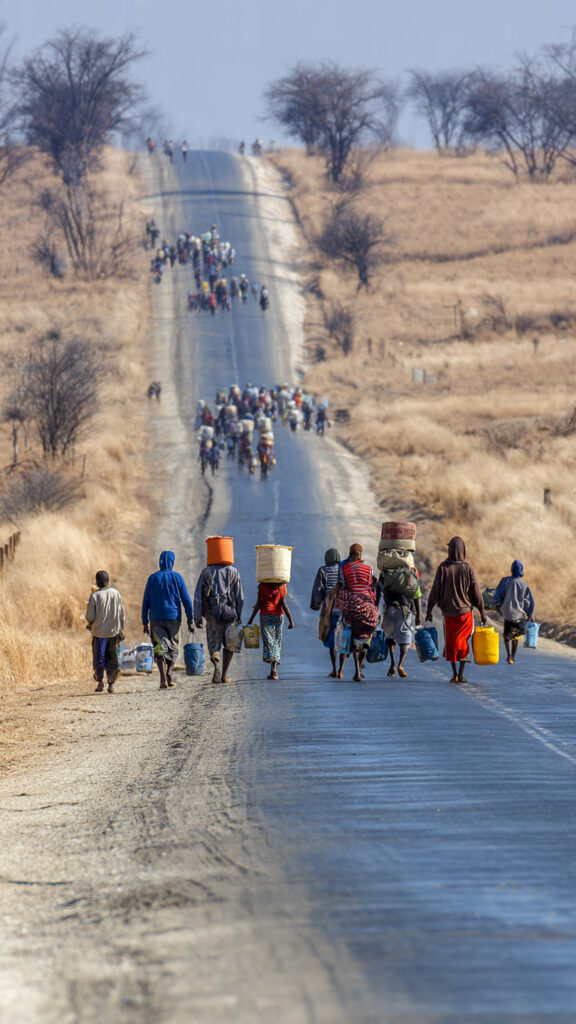
In March 2024, heavy flooding in Mozambique’s Zambezia Province displaced more than 120 000 people. Many migrants came from Malawi and Zimbabwe after prolonged droughts destroyed livelihoods. Urban informal settlements quickly became overcrowded. Southern Africa faces rising heat, stronger storms, floods, and droughts, making it one of the most climate‑vulnerable regions globally. (sipri.org)
Migration is increasingly a coping strategy. According to IOM and UNECA, climate‑related mobility in Africa is rising, yet many migrants lack legal recognition and protection. (africanclimatewire.org)
In South Africa, internal migration tied to climate stress is evident. A 2020 study in Gauteng showed that among 150 migrant men, two in five had moved from rural areas, and one in five of those reported living with HIV. This rate is three times higher than among non‑migrants (bhekisisa.org).
These examples highlight a key question: are SADC countries coordinating responses to climate‑migration, or acting independently?
Regional policy analysis: emerging coordination
Steps toward regional alignment
SADC has begun building frameworks for climate and migration governance. The Environment & Climate Change programme emphasises adaptation, disaster risk reduction, and livelihood resilience. (sadc.int)
The Climate Change Strategy and Action Plan 2020‑30 recognises that displacement and migration can result from climate shocks. (migrationnetwork.un.org)
On migration, SADC developed the Regional Migration Policy Framework in 2020 to promote orderly migration. (sadc.int)
These frameworks suggest emerging regional coordination. They allow member states to align national migration policies with regional guidelines while integrating climate‑adaptation and health concerns.
Remaining gaps
Despite progress, coordination is weak. A 2023 study found that National Adaptation Plans (NAPs) in Botswana, Mozambique, Namibia, South Africa, and Zimbabwe prioritised health but rarely linked it with migration and climate frameworks (annalsofglobalhealth.org).
Migration is often treated primarily as a security or border control issue, rather than a developmental, livelihood, or health concern (pmc.ncbi.nlm.nih.gov). Furthermore, SADC lacks a binding legal instrument dedicated to climate‑induced migration or migrant health. This absence leaves regional health protections inconsistent (sipri.org).
Many states still operate independently, which undermines cross‑border coordination on climate‑migration and health.
South Africa: health, migration, and climate stress
Empirical evidence
In South Africa, internal and cross‑border migration increasingly reflects climate stress. Statistics South Africa (2023) reports that land degradation and drought influence rural‑to‑urban migration (dffe.gov.za).
Migrants often settle in peri‑urban areas like Gauteng, eThekwini, and Cape Town. Housing is overcrowded, services are limited, and infectious disease risks are high (pmc.ncbi.nlm.nih.gov).
Anonymised case studies
Example 1: A 34‑year-old woman from rural KwaZulu‑Natal moved to Johannesburg in 2022 after failed maize seasons. She lives in a multi‑family informal dwelling without documentation. Her HIV treatment continuity was disrupted, and she fears engaging with health services.
Example 2: A 22‑year-old Mozambican male arrived in Pretoria in 2023 after flooding destroyed his home. He shares a single‑room shack with four others and works in the informal economy. He avoids TB screening due to fear of deportation.
These cases demonstrate layered vulnerabilities shaped by gender, age, nationality, and documentation. Health systems often fail to respond effectively to these intersecting risks.
Health-systems implications
Climate-driven migration affects South African health systems in several ways:
-
Continuity of care (HIV, TB, NCDs) is often interrupted.
-
Overcrowded, climate‑vulnerable housing increases disease risk and mental health stress.
-
Intersectional vulnerabilities exacerbate health disparities, particularly for women, youth, and undocumented migrants.
Policy gaps
-
Fragmented coordination: Health, migration, and climate policies operate in silos.
-
Lack of binding legal instruments: SADC does not have a protocol explicitly protecting climate migrants’ health.
-
Data limitations: Information disaggregated by nationality, age, gender, and documentation is scarce.
-
Cross-border health gaps: Migrants lose service continuity when moving across borders or provinces.
-
Under-addressed intersectionality: Policies often treat “migrant” as a homogeneous category.
-
Unequal capacities: Member states vary in infrastructure and service provision, leaving gaps in health support.
Innovative responses
-
The SADC Climate Change Strategy 2020‑30 includes migration considerations and sets a regional platform (unfccc.int).
-
South African research links water, food, and socioeconomic stress with migration and health risks (pmc.ncbi.nlm.nih.gov).
-
Data and monitoring initiatives highlight opportunities for integrating migration and health into adaptation planning.
-
NGOs in South Africa pilot migrant-friendly health outreach, combining mobile clinics with documentation support.
-
Existing SADC free-movement and labour frameworks provide a foundation for operationalising regional health coordination (sihma.org.za).
Recommendations and timelines
1. Establish SADC Taskforce on Climate‑Migration & Health
-
Launch in 6 months; first meeting Q2 2026.
-
Harmonise data, develop guidelines, coordinate cross-border referrals.
2. Develop a binding SADC Protocol
-
Draft by end 2026; ratify by mid‑2028.
-
Protect health rights, ensure service continuity, address documentation challenges.
3. Integrate migration-aware health planning
-
Implement 2025‑2027; monitor annually.
-
Audit facilities, strengthen outreach, track migrant service uptake.
4. Strengthen data, monitoring, and early-warning
-
Pilot 2025; scale regionally by 2027.
-
Track flows, climate triggers, health outcomes, and vulnerable subgroups.
5. Fund inclusive community adaptation programmes
-
Launch 2025‑2026; evaluate by 2028; scale to 2030.
-
Support origin and host communities with livelihoods, health, and legal services.
6. Prioritise intersectional research
-
Launch 2025; publish by 2027; integrate into policy by 2028.
-
Focus on gender, age, documentation, and health impacts.
Conclusion and calls to action
SADC is starting to coordinate climate‑migration responses, but gaps remain. Many states still manage the crisis individually.
Recent Posts:
- What can South Africa learn from Kenya’s approach to managing climate-displaced pastoralists in the Horn of Africa?
- How does climate migration intersect with existing xenophobia challenges in South Africa, and what policies could address both issues?
- What are the hidden connections between rising sea levels along South Africa’s coastline and internal displacement in communities like Durban and Port Elizabeth?
- How do recurring droughts in the Karoo region affect pastoral communities’ decisions to relocate, and where are they going?
- Are South African cities prepared for climate-induced migration waves, and what lessons can Johannesburg and Cape Town learn from global climate refugee strategies?