
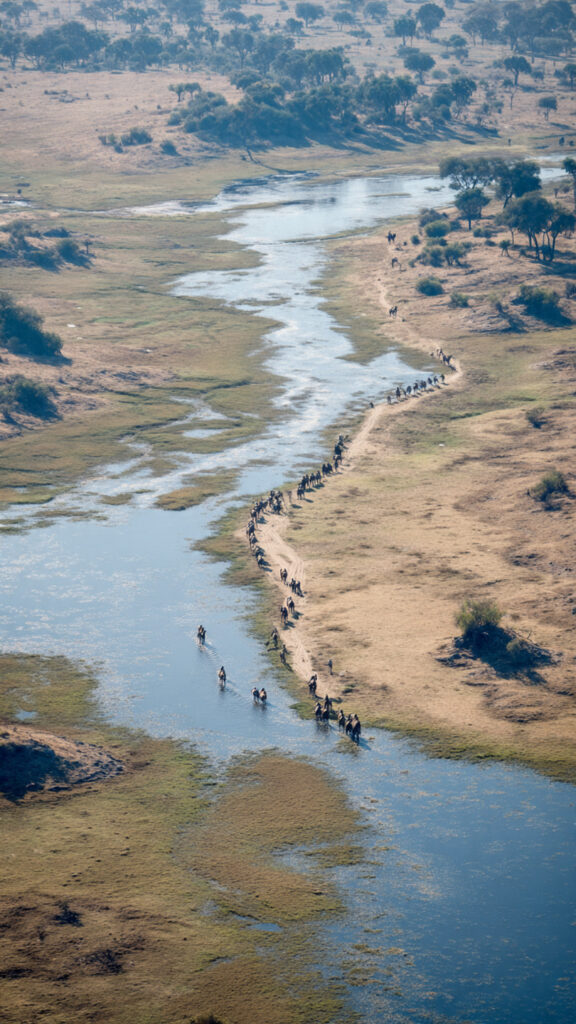
Drying of the Okavango Delta: Migration Health Implications for Botswana, Namibia, Angola and South Africa
The Okavango Delta, one of Botswana’s iconic ecosystems, is facing severe environmental stress. Rainfall in the Delta catchment—the Angolan highlands and Namibia—has dropped to the lowest levels since 1981. (neweralive.na) Six villages in the Boro/Xharaxao area were abandoned due to drought. (blogs.lossanddamageobservatory.org)
Environmental changes are driving migration. As water tables drop and flood cycles fail, traditional livelihoods collapse. Consequently, communities are moving across borders. These shifts create new health vulnerabilities for both migrants and host countries, including South Africa.
Migration Drivers from the Delta Region
Environmental Stress and Livelihood Loss
The Delta relies on floodwaters from the Cubango and Cuito rivers in Angola. Rising temperatures and declining rainfall are reducing inflows. Local fishing, agriculture, and tourism are collapsing. The Okavango Kopano Mokoro Community Trust reported that affected migrants in Maun face unemployment and hunger. (blogs.lossanddamageobservatory.org)
Transboundary Mobility
Communities increasingly seek work or safety across borders. The Adaptation Fund notes that pastoralists and small-scale farmers will migrate in search of water, pasture, and livelihoods. (adaptation-fund.org) Climate hazards are becoming a key driver of migration in the SADC region. (bpb.de)
Implications for South Africa
South Africa hosts over 4.2 million international migrants, around 7% of its population. (webapps.ilo.org) While migration from the Delta basin is indirect, environmental stress may increase onward movement into South Africa.
Policy Analysis: Gaps, Risks, and Implications
Weak Linkage Between Environmental Change and Migration Health
Botswana, Namibia, and Angola focus mainly on water management, not migration health. For example, Botswana’s Third National Communication notes declining Delta inflows but ignores human mobility or health outcomes. (unfccc.int)
Fragmented Transboundary Governance
OKACOM focuses on water and ecology but overlooks cross-border migration health. (whc.unesco.org) Rising water stress may increase movement, yet monitoring systems are weak.
South Africa’s Healthcare Access for Non-Citizens
The constitution guarantees healthcare for everyone (Section 27[1]). (sundayworld.co.za) The National Health Act allows free primary care regardless of nationality. (wits.ac.za) However, conflicting statements and xenophobic acts have limited access. (timeslive.co.za)
Health System Readiness and Intersectional Vulnerabilities
Migrants face multiple vulnerabilities: women, children, older adults, persons with disabilities, and undocumented individuals. For instance, female polers in Botswana migrate due to lost livelihoods. (iied.org) Access to HIV, maternal, and mental health services is limited, especially in urban South African contexts. (wwmp.org.za)
Empirical Evidence and Anonymised Examples
Example 1 – Lerato, 29, Botswana
A Mokoro guide from Xharaxao village, she lost her job after droughts reduced tourism. Migrating to Maun caused overcrowding and delayed TB screening.
Example 2 – Samuel, 52, Angola → Namibia
Reduced grazing forced him into northern Namibia. He cannot reliably access HIV treatment due to documentation and transport barriers.
Example 3 – Aisha, 18, Zambia → South Africa
Drought destroyed her family’s maize crop. Living in an informal settlement, she faces limited maternal care and anxiety.
These examples highlight intersecting risks: environmental stress, migration, health vulnerabilities, and service gaps.
Innovative Solutions & Promising Practices
Community-Led Adaptation
OKMCT supports boreholes, climate-smart agriculture, and tourism alternatives to reduce forced migration.
Mobile Health Clinics
Deploying mobile clinics along transit routes can provide TB screening, ART, maternal care, and mental health services.
Regional Migration-Health Monitoring
SADC could develop a platform tracking climate-linked displacement and health outcomes to inform early-warning and service planning.
Inclusive Health Policy Reform
South Africa could pilot migrant-friendly clinics with legal support desks, translators, and ART/maternal care referral systems in high-arrival cities.
Actionable Recommendations
| Stakeholder | Recommendation | Timeline |
|---|---|---|
| Governments (Botswana, Namibia, Angola) | Conduct migration-health vulnerability assessments in Delta regions. | 0-12 months |
| OKACOM + SADC | Establish a regional migration-health working group. | 6-18 months |
| South Africa NDoH & Provinces | Pilot migrant-inclusive health access points in high-arrival cities. | 6-24 months |
| NGOs & CBOs | Support livelihood diversification and outreach to migrating populations. | 0-24 months |
| Academic/Research Institutions | Conduct longitudinal studies on migration and health outcomes. | 12-36 months |
Implications for South Africa
-
Health systems may face surges in vulnerable migrants requiring TB, HIV, maternal care, and mental health support.
-
Exclusion of migrants increases public health risks.
-
Informal settlement pressures will intensify.
-
Policies must address intersectional vulnerabilities and clarify health entitlements.
Limitations and Research Gaps
-
Limited empirical data on Delta-origin migration to South Africa.
-
Causal links between Delta drying and migration need more study.
-
Health system data lacks nationality/migration status disaggregation.
-
Intersectional vulnerabilities remain under-researched.
Conclusion & Call to Action
The Okavango Delta’s decline affects mobility, livelihoods, and health across Botswana, Namibia, Angola, and South Africa. Policymakers, health practitioners, NGOs, and researchers must act now.
-
Governments: Integrate migration-health into climate and water policies.
-
South Africa: Clarify migrant health entitlements and pilot inclusive clinics.
-
NGOs/CBOs: Link livelihood programs with migration-health support.
-
Researchers: Study Delta migration, health outcomes, and intersectional risks.
Proactive engagement along the Okavango corridor will safeguard both human dignity and public health resilience.
Recent Posts:
- Are SADC countries developing coordinated responses to climate migration, or is each nation navigating the crisis alone?
- What can South Africa learn from Kenya’s approach to managing climate-displaced pastoralists in the Horn of Africa?
- How does climate migration intersect with existing xenophobia challenges in South Africa, and what policies could address both issues?
- What are the hidden connections between rising sea levels along South Africa’s coastline and internal displacement in communities like Durban and Port Elizabeth?
- How do recurring droughts in the Karoo region affect pastoral communities’ decisions to relocate, and where are they going?