
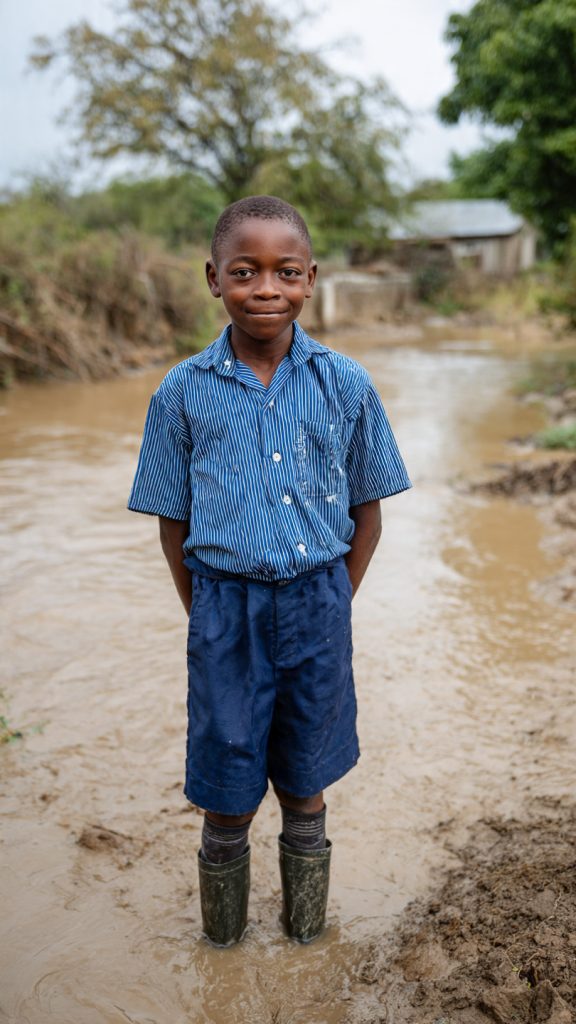
The Catastrophe Unfolding: Climate Disruption Displaces Students Across the Region
Across Southern Africa, climate disasters are striking faster and with greater intensity than ever before. In Mozambique alone, successive cyclones—Cyclone Idai in 2019 and Cyclones Eloise and Ana between 2021 and 2022—displaced nearly 600,000 people and destroyed more than 3,500 schools. Yet statistics reveal only part of the crisis.
Consider Amani, a 13-year-old girl from Gaza Province in Mozambique. When Cyclone Idai struck, floodwaters swept away both her family’s home and the school she attended. For the following six months, she did not attend classes. Instead, her parents needed help caring for younger siblings while they struggled to rebuild their lives.
When classes finally resumed in a temporary shelter, learning conditions were extremely difficult. Teachers lacked textbooks, classrooms, and basic learning materials. Consequently, Amani—like millions of children across southern Africa—fell significantly behind in her education.
The Scale of Educational Disruption
The magnitude of the problem is staggering. Between 2014 and 2024, climate-driven disasters disrupted schooling for approximately 12.3 million children across the Southern African Development Community (SADC) region. According to the World Bank, every year of schooling lost reduces an individual’s lifetime earnings by roughly 10 percent.
For the SADC region, this loss translates into more than $2.4 billion in foregone economic output annually, a cost that compounds across generations (World Bank, 2023).
When Education Loss Becomes a Health Crisis
Education disruption is not simply an academic problem—it is also a public health emergency.
Children who miss prolonged periods of schooling experience poorer health outcomes. For example, vaccination uptake often declines, nutritional status worsens, and exposure to infectious diseases such as malaria increases. Moreover, prolonged school absence increases vulnerability to sexual exploitation and early pregnancy.
Girls face particularly severe consequences. According to UNESCO (2022), 30–40 percent of girls who become pregnant during extended school absences never return to education.
Despite these risks, most governments, NGOs, and health systems still treat education disruption as separate from health security. However, the evidence increasingly suggests that this division is both artificial and dangerous.
The Policy Gap: Why Education and Climate Are Missing from Health Planning
Across southern Africa, ministries of health rarely coordinate with education or environmental departments on climate adaptation strategies. As a result, policy blind spots continue to undermine both education and health outcomes.
Fragmented Policy Architecture
In many SADC countries, policy frameworks operate in isolated institutional silos.
Education ministries primarily focus on curriculum design and teacher training. Consequently, they often lack dedicated funding for climate-resilient school infrastructure or disaster preparedness.
Meanwhile, health systems concentrate largely on disease treatment rather than upstream determinants such as education. Yet schooling significantly shapes health literacy, prevention behaviors, and long-term health outcomes.
Environmental agencies, on the other hand, manage disaster response once floods or droughts occur. However, these agencies rarely integrate climate risk analysis into sector-specific planning for education or public health.
Because of this fragmented policy architecture, climate risks frequently go unaddressed in education planning.
For instance, Zambia’s updated education policy framework (2023) allocates only 2.1 percent of resources to climate resilience, despite experiencing severe drought during four of the past eight years. Similarly, Zimbabwe’s National Education Blueprint (2015–2022) contains no measurable climate adaptation indicators.
In South Africa, the situation is also uneven. Provincial education departments lack standardized protocols for climate-related school closures, which has resulted in learning recovery delays of up to 18 months after closures (Department of Basic Education, 2023).
Health Consequences of School Closures
When climate disasters force schools to close, immediate health consequences often follow.
Vaccination Gaps
School-based health programs deliver between 60 and 70 percent of routine childhood immunizations in many SADC countries. Consequently, prolonged school closures interrupt vaccination schedules and create cohorts of under-immunized children.
Between 2019 and 2021, Mozambique experienced a 23 percent decline in measles vaccination coverage in drought-affected provinces (UNICEF, 2022).
Malnutrition
School meal programs provide essential nutrition for millions of children, particularly in rural communities. When schools close, vulnerable children lose access to these meals.
Studies conducted in Zimbabwe and Malawi show that children missing more than three consecutive months of school feeding programs experience average weight loss of 1.2–1.8 kg. In addition, stunting prevalence increases by 8–12 percentage points (Chirwa & Mvula, 2021).
Increased Sexual Violence
Extended school closures also increase vulnerability to gender-based violence.
Girls who are out of school face significantly higher risks of early marriage and pregnancy. For example, during drought years in rural Mozambique (2015–2017), marriage proposals for girls aged 12–17 increased by 34 percent. At the same time, pregnancy complications became the leading cause of death among adolescent girls in this age group (Ministry of Health Mozambique, 2018).
Declining Health Literacy
Schools are critical sites for teaching water sanitation, reproductive health, and disease prevention. When children miss school, this knowledge transfer is interrupted.
Following Zimbabwe’s 2015–2016 drought, cholera outbreaks occurred 4.2 times more frequently in areas where schools were closed for more than 180 days compared to areas with minimal closures (Mugumanji et al., 2020).
Intersectional Vulnerabilities Deepen Inequality
Climate-driven education disruption does not affect all children equally. Instead, vulnerability is shaped by gender, age, disability, and migration status.
Gender Inequality
Girls already face significant barriers to education across the SADC region. These barriers include safety concerns, menstrual poverty, and limited female teacher representation.
During climate disasters, these challenges intensify. Families often prioritize sending boys to temporary learning centers because of safety and cultural concerns. As a result, girls’ attendance frequently drops two to four times faster than boys’ attendance (OXFAM, 2021).
For example, in rural Malawi, girls’ primary school enrollment fell 22 percent during the 2015–2016 drought, compared to an 11 percent decline among boys (Kumapley et al., 2019).
Age and Disability
Younger children aged six to ten experience the most severe learning losses because they miss foundational literacy and numeracy development.
Children with disabilities face additional barriers. Across southern Africa, schools employ 68 percent of trained special education teachers. Consequently, when schools close, access to specialized instruction, therapy services, and mobility support disappears (CBM, 2022).
Migration Status
Migration also intensifies educational vulnerability.
The SADC region hosts approximately 4.2 million international migrants and 26 million internally displaced persons, many of whom move because of climate pressures. Migrant children are 3.1 times more likely to be out of school than native-born peers (IOM, 2023).
When climate disasters strike, migrant families often relocate again, creating repeated interruptions to children’s education.
Evidence from the Ground: Cities and Rural Communities Across SADC
Botswana: Drought and Urban Migration
Botswana experienced severe drought between 2015–2017 and again between 2022–2024. As rural water shortages intensified, many families migrated to cities such as Gaborone and Francistown.
Consequently, school enrollment in drought-affected rural districts fell by 31 percent, while urban schools became overcrowded.
In Francistown informal settlements, class sizes reached 110 students per teacher.
A teacher described the conditions:
“We have one textbook per class. Thirty children share one desk. There is no water for handwashing toilets, no soap, and no sanitation pads for girls. Disease spreads fast here.”
Health assessments among migrant children revealed troubling disparities. Compared with non-migrant peers, migrant students experienced:
-
Malaria prevalence: 12.8% vs 4.2%
-
Anemia: 37.4% vs 18.1%
-
Stunting: 19.3% vs 8.9%
Girls from migrant households also reported unprotected sexual activity at 2.8 times the rate of non-migrant students (Ministry of Education Botswana & UNICEF, 2023).
Mozambique: Cyclones Destroy Infrastructure
Cyclone Idai destroyed 1,247 schools across Gaza and Sofala provinces.
Temporary learning structures—often open-air shelters—provided limited protection from rain and mosquitoes. Consequently, children faced increased exposure to malaria and dengue.
Three years later, many schools remained unreconstructed.
A school principal in Sofala explained:
“We rebuilt with rain, not roofing. Teachers hold umbrellas while teaching mathematics.”
Among 340 children surveyed two years after the cyclone:
-
34% missed vaccination schedules
-
18% suffered acute malnutrition
-
42% could not read at age-appropriate levels
Additionally, 19 percent of girls aged 15–17 reported pregnancy or marriage in the two-year post-cyclone period (Save the Children, 2023).
South Africa: Inequality During the Water Crisis
The 2015–2018 “Day Zero” water crisis in Cape Town exposed deep educational inequalities.
While affluent schools transitioned to online learning, lower-income schools simply closed. In townships such as Khayelitsha and Mitchells Plain, closures lasted over 180 days.
A school nurse described the impact:
“We had a thousand students and no running water. We couldn’t teach hygiene because there was no water.”
Research tracking 450 students revealed major disparities:
-
Low-income students missed 134 school days on average
-
Affluent students missed 42 days
Furthermore, diarrheal disease increased 340 percent in low-income communities during the crisis (Mathenjwa et al., 2021).
Recent Posts:
- Cyclones, Conflict, and Kids: The Triple Threat Facing Children in Mozambique’s Cabo Delgado
- Can SADC Protect Climate-Displaced Children? A Critical Look at Regional Frameworks
- Madagascar’s Hunger Crisis: Why Climate-Driven Famine is Pushing Children Across SADC Borders
- SADC’s Climate Orphans: What Happens to Children When Parents Migrate Due to Environmental Disasters?
- Lesotho’s Disappearing Snow, Disappearing Children: Climate Migration from the Mountain Kingdom