
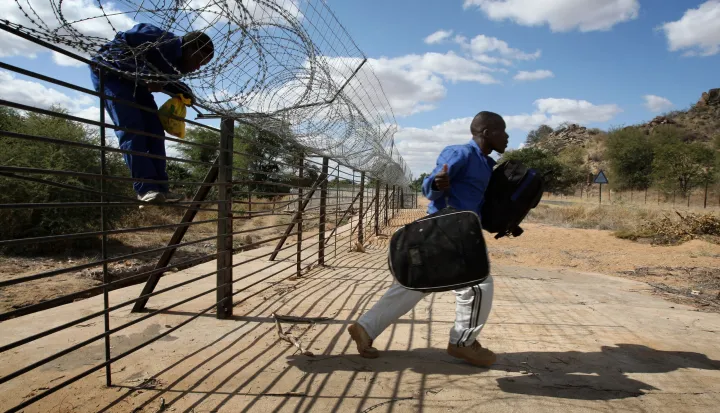
South Africa and Securitisation of Migration Governance
South Africa has become a significant destination for migrants from across Africa and beyond since its transition to democracy in 1994. As one of the continent’s most developed economies, it has attracted people seeking better economic opportunities, as well as those fleeing political instability and conflict. However, the governance of migration in South Africa has increasingly become characterized by securitisation—a process whereby migration is framed as a security threat rather than a humanitarian, economic, or social phenomenon. This shift has profound implications for both migrants and South African society.
This blog post examines the securitisation of migration governance in South Africa, exploring its historical roots, current manifestations, impacts, and potential alternatives. By critically analyzing this approach, we can better understand the complex dynamics at play and identify more constructive paths forward.
Historical Context: Migration and Security in South Africa
South Africa’s approach to migration has deep historical roots in its colonial and apartheid past. During apartheid, migration control was instrumental in maintaining racial segregation and ensuring a steady supply of labor for mines and farms while limiting migrants’ rights and mobility (Peberdy, 2009). The apartheid government constructed a system of migrant labor that served economic interests while enforcing rigid control over population movement.
After the transition to democracy in 1994, there was initially optimism about reform in migration policy. The new government committed to human rights principles and regional integration. However, as Crush and McDonald (2001) note, the practical implementation of migration governance quickly reverted to control-oriented approaches, even as the rhetoric changed.
The 1998 Refugees Act and 2002 Immigration Act established the current legal framework, ostensibly balancing humanitarian commitments with national interests. However, as Landau (2010) argues, these laws have often been implemented in ways that prioritize securitisation over rights protection.
Conceptualizing Securitisation in Migration Governance
Securitisation refers to the process by which issues become defined as security threats through speech acts and practices that frame them as existential dangers requiring exceptional measures (Buzan et al., 1998). In the context of migration, securitisation involves portraying migrants as threats to national security, economic stability, or social cohesion.
In South Africa, this process has been evident in political discourse, policy development, and everyday practices of migration management. Segatti (2011) identifies several key aspects of this securitisation:
- The framing of migrants as potential criminals, terrorists, or threats to public health
- The militarization of border control
- The increased use of detention and deportation
- The development of sophisticated surveillance systems for tracking foreigners
These practices reflect what Hammerstad (2012) describes as the “securitisation paradox”—where measures ostensibly designed to increase security often create new insecurities for both migrants and citizens.
Current Manifestations of Securitisation
Legal and Policy Framework
South Africa’s migration policy framework increasingly reflects securitisation tendencies. The 2017 White Paper on International Migration explicitly frames migration management as a security issue, emphasizing risk assessment, enhanced vetting, and stricter border controls (Department of Home Affairs, 2017).
More recently, the Border Management Authority Act of 2020 established a dedicated agency with expanded powers to control cross-border movement, reflecting what critics see as further militarization of migration management (Solomon, 2019). This centralization of border control under a single authority with law enforcement powers represents a clear shift toward securitisation.
Institutional Practices
The Department of Home Affairs’ approach to processing asylum seekers and migrants reveals securitisation in practice. Long waiting periods, high rejection rates, and limited appeal options characterize a system that Amit (2015) describes as “protection on paper, rejection in practice.” The closure of several Refugee Reception Offices has further complicated access to protection.
Joint operations between immigration officials, police, and military personnel—such as Operations Fiela and Corona—exemplify the criminalization of migrants through targeted raids and mass deportations. These operations, ostensibly focused on crime reduction, disproportionately target foreign nationals (Mukwevho, 2020).
Political Discourse and Public Perception
Political rhetoric often contributes to securitisation through what Neocosmos (2010) terms “state talk”—discourse that positions migrants as threats to jobs, housing, and security. This rhetoric is particularly noticeable during election periods when anti-immigrant sentiment becomes a political tool.
Media coverage frequently reinforces these securitised framings by emphasizing criminal activities involving foreigners while underreporting positive contributions of migrants (Danso & McDonald, 2001). This selective reporting contributes to what Nyamnjoh (2006) identifies as “negrophobic xenophobia”—discrimination specifically targeting Black African migrants.
Impacts and Consequences
For Migrants and Asylum Seekers
The securitisation of migration governance has dire consequences for migrants and asylum seekers. Many face:
- Arbitrary detention and deportation, often without due process
- Limited access to documentation and legal status
- Barriers to essential services like healthcare and education
- Vulnerability to exploitation by employers and officials
- Xenophobic violence exacerbated by securitised discourse
As Vigneswaran (2008) documents, these outcomes create profound insecurity for migrants, contradicting the very purpose of security-focused governance.
For South African Society
The securitisation approach also impacts South African society broadly:
- It diverts resources from development priorities to border enforcement and detention
- It undermines regional integration efforts and diplomatic relationships
- It fosters social division and xenophobic attitudes
- It contradicts constitutional commitments to human rights and dignity
Critically, as Landau and Freemantle (2010) argue, securitisation fails to address the root causes of migration or provide sustainable solutions to migration challenges.
Alternative Approaches
Several scholars and advocacy organizations have proposed alternatives to securitisation:
Rights-Based Governance
A rights-based approach would prioritize the protection of migrants’ basic rights regardless of status. This approach, advocated by organizations like Lawyers for Human Rights (2018), emphasizes access to documentation, fair procedures, and protection from arbitrary detention and deportation.
Development-Focused Regional Cooperation
Regional approaches that address the root causes of migration through development cooperation offer more sustainable solutions. As Crush and Chikanda (2014) suggest, partnerships that focus on shared prosperity rather than border control may better serve both sending and receiving countries.
Evidence-Based Policy
Migration policy based on accurate data rather than securitised assumptions would better reflect migration’s actual impacts. Research by the African Centre for Migration & Society (2020) demonstrates that migrants often contribute positively to host economies through entrepreneurship, skills transfer, and tax contributions—challenging security-focused narratives.
Conclusion
The securitisation of migration governance in South Africa represents a concerning trend with negative consequences for migrants and South African society alike. By framing migration primarily as a security threat, this approach undermines rights protections, regional relationships, and potential benefits of well-managed migration.
Moving beyond securitisation requires acknowledging migration as a complex social phenomenon with multiple dimensions—economic, humanitarian, cultural, and political. Only through nuanced understanding and balanced policy approaches can South Africa effectively govern migration in ways that respect human dignity, promote development, and enhance genuine security for all who live within its borders.
References
African Centre for Migration & Society. (2020). Migration and the inclusive city: Migration, livelihoods and urban governance. University of the Witwatersrand.
Amit, R. (2015). Queue here for corruption: Measuring irregularities in South Africa’s asylum system. Lawyers for Human Rights and the African Centre for Migration & Society.
Buzan, B., Wæver, O., & De Wilde, J. (1998). Security: A new framework for analysis. Lynne Rienner Publishers.
Crush, J., & Chikanda, A. (2014). Forced migration in Southern Africa. In E. Fiddian-Qasmiyeh, G. Loescher, K. Long, & N. Sigona (Eds.), The Oxford handbook of refugee and forced migration studies. Oxford University Press.
Crush, J., & McDonald, D. A. (2001). Introduction to special issue: Evaluating South African immigration policy after apartheid. Africa Today, 48(3), 1-13.
Danso, R., & McDonald, D. A. (2001). Writing xenophobia: Immigration and the print media in post-apartheid South Africa. Africa Today, 48(3), 115-137.
Department of Home Affairs. (2017). White paper on international migration for South Africa. Republic of South Africa.
Hammerstad, A. (2012). Securitisation from below: The relationship between immigration and foreign policy in South Africa’s approach to the Zimbabwe crisis. Conflict, Security & Development, 12(1), 1-30.
Landau, L. B. (2010). Loving the alien? Citizenship, law, and the future in South Africa’s demonic society. African Affairs, 109(435), 213-230.
Landau, L. B., & Freemantle, I. (2010). Tactical cosmopolitanism and idioms of belonging: Insertion and self-exclusion in Johannesburg. Journal of Ethnic and Migration Studies, 36(3), 375-390.
Lawyers for Human Rights. (2018). Monitoring immigration detention in South Africa. Pretoria: LHR.
Mukwevho, H. (2020). Operation Corona: The militarisation of South Africa’s borders. African Security Review, 29(2), 136-156.
Neocosmos, M. (2010). From ‘foreign natives’ to ‘native foreigners’: Explaining xenophobia in post-apartheid South Africa. CODESRIA.
Nyamnjoh, F. B. (2006). Insiders and outsiders: Citizenship and xenophobia in contemporary Southern Africa. CODESRIA.
Peberdy, S. (2009). Selecting immigrants: National identity and South Africa’s immigration policies 1910-2008. Wits University Press.
Segatti, A. (2011). Reforming South African immigration policy in the postapartheid period (1990-2010). In A. Segatti & L. B. Landau (Eds.), Contemporary migration to South Africa: A regional development issue (pp. 31-66). World Bank.
Solomon, H. (2019). Towards a single Border Management Authority in South Africa. Strategic Review for Southern Africa, 41(2), 107-129.
Vigneswaran, D. (2008). A foot in the door: Access to asylum in South Africa. Refuge: Canada’s Journal on Refugees, 25(2), 41-52.