
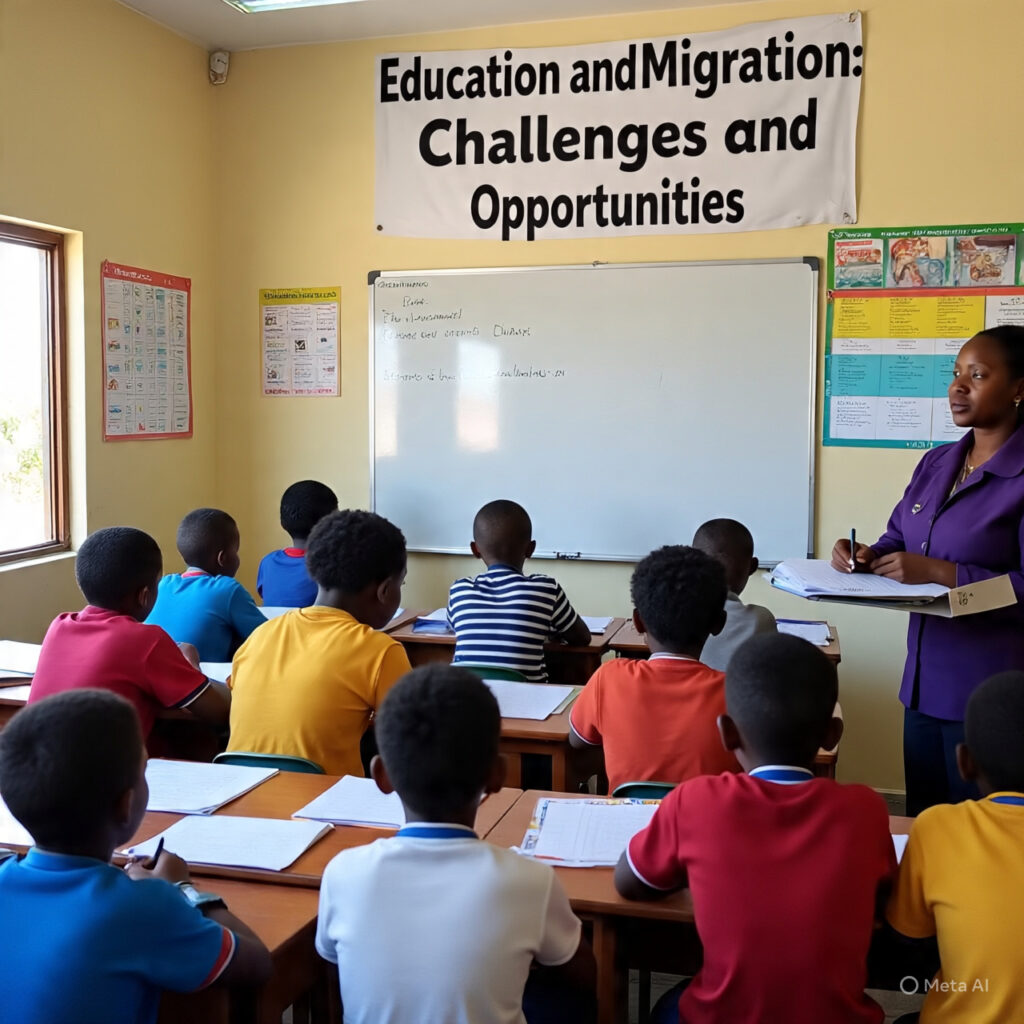
Education and Migration
1. Compelling Opening: Statistics & Case Study
Case Study Snapshot: “Amina’s First Day”
Amina*, a 10-year-old refugee from the DRC, arrived at a Johannesburg township school in 2024. Despite her curiosity, she could not understand lessons, relied on Google Translate, felt isolated, and soon fell behind.
Key Statistics (2020–2025)
-
Around 5% of South Africans are foreign-born—approx. 2.5 million people—with many school-age children among them ERIC.
-
80%+ of South African learners are educated in a language other than their mother tongue, while only 7% speak English at home, yet 99% use English as Language of Learning and Teaching (LOLT) by Grade 4 ERIC.
-
Beginning in 2025, South Africa will begin implementing mother-tongue-based bilingual education (MTbBE) from Grade 4 ERIC.
-
In late 2023, policy shifted to allow children of undocumented foreign nationals to register for admission without ID documentation—a landmark move for inclusive access SIHMA.
This introduction highlights the lived experience of a migrant student—Amina—as a window into systemic language and inclusion barriers, setting the stage for a rigorous policy and programmatic analysis.
2. Comprehensive Policy Analysis & Gaps
Legal & Constitutional Basis
-
The Constitution (1996) guarantees the right to basic education (Section 29) and prohibits unfair discrimination UPSpace RepositoryWikipedia.
-
The South African Schools Act (1996) enables school choice and forbids impediments to access ERICWikipedia.
-
The Basic Education Laws Amendment (BELA) Act 2024 mandates Grade R attendance and requires multilingual teaching where practicable WikipediaThe Guardian.
Recent Policy Shifts
-
2023: Admission of undocumented migrant children no longer requires documentation SIHMA.
-
2025: Introduction of MTbBE to strengthen linguistic inclusion and cognitive development ERIC.
-
BELA 2024: Allows provincial override in school admission; promotes multilingual instruction to counteract apartheid-era exclusion The Guardian.
Identified Gaps & Challenges
-
Policy–Practice Divide:
-
Despite constitutional guarantees, immigrant learners often face exclusion in practice—especially if undocumented or with expired permits UPSpace RepositoryERIC.
-
-
Language Transition Gaps:
-
English-dominant LOLT clashes with learners’ home languages; FAL (First Additional Language) classes are insufficient ERIC.
-
-
No Formal Guidelines for Teachers:
-
Teachers lack training or guidelines to meaningfully support multilingual immigrant learners ResearchGateSciELO.
-
-
Psychosocial & Social Integration Needs:
-
Language barriers foster isolation, bullying, and inhibited psychosocial development ResearchGate.
-
Documentation insecurity and xenophobia further impede school participation SciELO.
-
3. Empirical Evidence from Major SA Cities
Johannesburg (Three2Six Project)
-
The Three2Six initiative in Johannesburg supports migrant and refugee learners with registration assistance and classes, addressing documentation, xenophobia, and systemic exclusion JLI.
Gauteng (Gauteng Foundation‐Phase Study)
-
A study across three former Model C schools in Gauteng illustrates how language barriers hinder integration, emotional well-being, and peer relationships; immigrant learners often experience isolation and bullying ResearchGate.
Krugersdorp Secondary Setting
-
In Krugersdorp, migrant learners face multiple challenges—lack of documentation, language hurdles, and adaptation issues hinder schooling continuation despite resilience SciELO.
Cape Town & Beyond
-
Multilingual Immigrant Learner Identities (MILI) research examines Grade 6 immigrant learners from neighbouring countries, highlighting how learners draw on their home languages to navigate schooling and identity formation Taylor & Francis Online.
4. Two–Three Anonymized Examples
Example 1: “Amina,” Johannesburg Township
As introduced—struggles with English instruction, absent language support, social isolation.
Example 2: “John,” Krugersdorp Secondary
“John,” a secondary school learner from Zimbabwe, has a study permit that expired. He attended classes pending renewal, but was threatened with deregistration, exacerbating stress and interrupting school continuity. His teachers lacked clarity on legal protections or pathways UPSpace RepositorySciELO.
Example 3: “Nandi,” Former Model C School, Gauteng
“Nandi,” originally from Malawi, was placed in English-only instruction at age 7. Her foundation-phase teachers lacked psychosocial frameworks. She was isolated and exhibited withdrawn behavior. Teachers had no mandates to adapt literacy instruction to support her multilingual development ResearchGateSciELO.
5. Innovative Solutions & Successful Programs
Program: Three2Six (Johannesburg)
-
Provides tailored remediation, documentation support, psychosocial services, and integration for refugee learners, enabling them to eventually enter mainstream schooling JLI.
Policy Innovation: MTbBE (2025)
-
The Department of Basic Education’s rollout of mother-tongue-based bilingual education from Grade 4 aims to address multilingual needs, improve comprehension, and reduce exclusion ERIC.
Resource Innovation: African Storybook Initiative
-
A Johannesburg-based nonprofit, African Storybook, provides open-license multilingual early reading materials in African languages—over 3,800 original titles and 7,266 translations—enabling inclusive literacy development and home-language support Wikipedia.
Multilingual Teaching Mandate (BELA 2024)
-
The new law empowers provinces to require multilingual instruction, potentially undoing language-based exclusion and promoting inclusion in historically rigid language-medium schools The Guardian.
6. Actionable Recommendations with Timelines
| Stakeholder | Recommendation | Timeline |
|---|---|---|
| DBE & Provincial Depts | ● Fast-track MTbBE rollout; provide curriculum and teacher training. ● Disseminate clear guidance on undocumented learner admission. ● Fund psychosocial and language-support programs in high-migrant districts. |
Medium (2025–2026) |
| School Leadership & SGBs | ● Develop inclusive language policies; support ESL and multilingual materials. ● Partner with NGOs (e.g. Three2Six, Storybook) for learner support. ● Train staff on anti-xenophobia and inclusive practices. |
Medium (2025–2027) |
| Teachers & Unions | ● Apply inclusive language pedagogy; integrate sociocultural content. ● Participate in MTbBE and psychosocial training. ● Track and support vulnerable learners proactively. |
Short–Medium (2025–2026) |
| NGOs & Community Orgs | ● Scale models like Three2Six to other cities (Cape Town, Durban). ● Provide multilingual resources (Storybook). ● Advocate for implementation fidelity and monitor xenophobia. |
Immediate to Medium |
| Donors & Development Partners | ● Fund language and psychosocial support programs. ● Support teacher development and curriculum adaptation. ● Commission rigorous evaluations to inform policy scale-up. |
Immediate–Medium |
7. Conclusion & Calls to Action
South Africa stands at a pivotal moment as its education policy recalibrates to include a growing, diverse student population. Recent legal reforms—such as welcoming undocumented learners and introducing MTbBE—represent fertile ground for inclusion. However, the gulf between policy and lived experience persists.
Calls to Action:
-
DBE & policymakers must ensure clear, inclusive implementation backed by teacher training, funding, and oversight.
-
School leaders should foster inclusive environments, leveraging multilingual materials and community partnerships.
-
Educators and unions must champion language-sensitive pedagogy and protect migrant learners’ psychosocial well-being.
-
NGOs and donors play a vital role in piloting scalable interventions and holding systems accountable.
-
Researchers should fill knowledge gaps—especially on longitudinal outcomes, implementation efficacy, and South–South migration dynamics—as identified in our evidence review.
Limitations and Research Gaps: Most studies rely on small qualitative samples (e.g. three schools, three districts), limiting national generalizability. Intersectional factors—gender, age, nationality, documentation status—are underexamined in quantitative datasets. More robust, multisite, mixed-method data across diverse settings are needed to guide scalable policy design.
With coordinated effort from government, educators, civil society, and researchers, South Africa can transform its schools into truly inclusive spaces—where a child like Amina is not just admitted but supported to thrive.
References
-
Ngema & D’amant (2025) – inclusive education and migrant learners ERIC
-
Spaull et al. (2016/2024) – language statistics ERIC
-
Dept. of Basic Education (2024) – MTbBE rollout ERIC
-
Motsoaledi (2023) – undocumented learner admission policy SIHMA
-
South African Schools Act (1996) Wikipedia
-
BELA Act (2024) WikipediaThe Guardian
-
Three2Six project (Johannesburg) JLI
-
Gauteng Foundation Phase study (Model C schools) ResearchGate
-
Krugersdorp schooling study SciELO
-
MILI (Grade 6 learners) Taylor & Francis Online
-
African Storybook initiative Wikipedia
-
Documentation & xenophobia in Ekurhuleni East UPSpace Repository
-
Lack of teacher guidelines SciELO
-
Sociocultural integration & documentation issues SciELO
-
Language attitude and policy debates (Guardian 2024) The Guardian
Recent Posts:
- Media Representation and Migration: How Narratives Shape Public Opinion in South Africa
- Building Inclusive Communities: Success Stories of Integration in South Africa
- Skills Migration in South Africa: Brain Drain vs. Brain Gain
- Urban Planning and Migration: Infrastructure Challenges in South African Cities – A Health Policy Analysis
- The Economic Impact of Migration on South African Communities: A Health Policy Perspective